Episode Transcript
[00:00:00] Speaker A: Foreign.
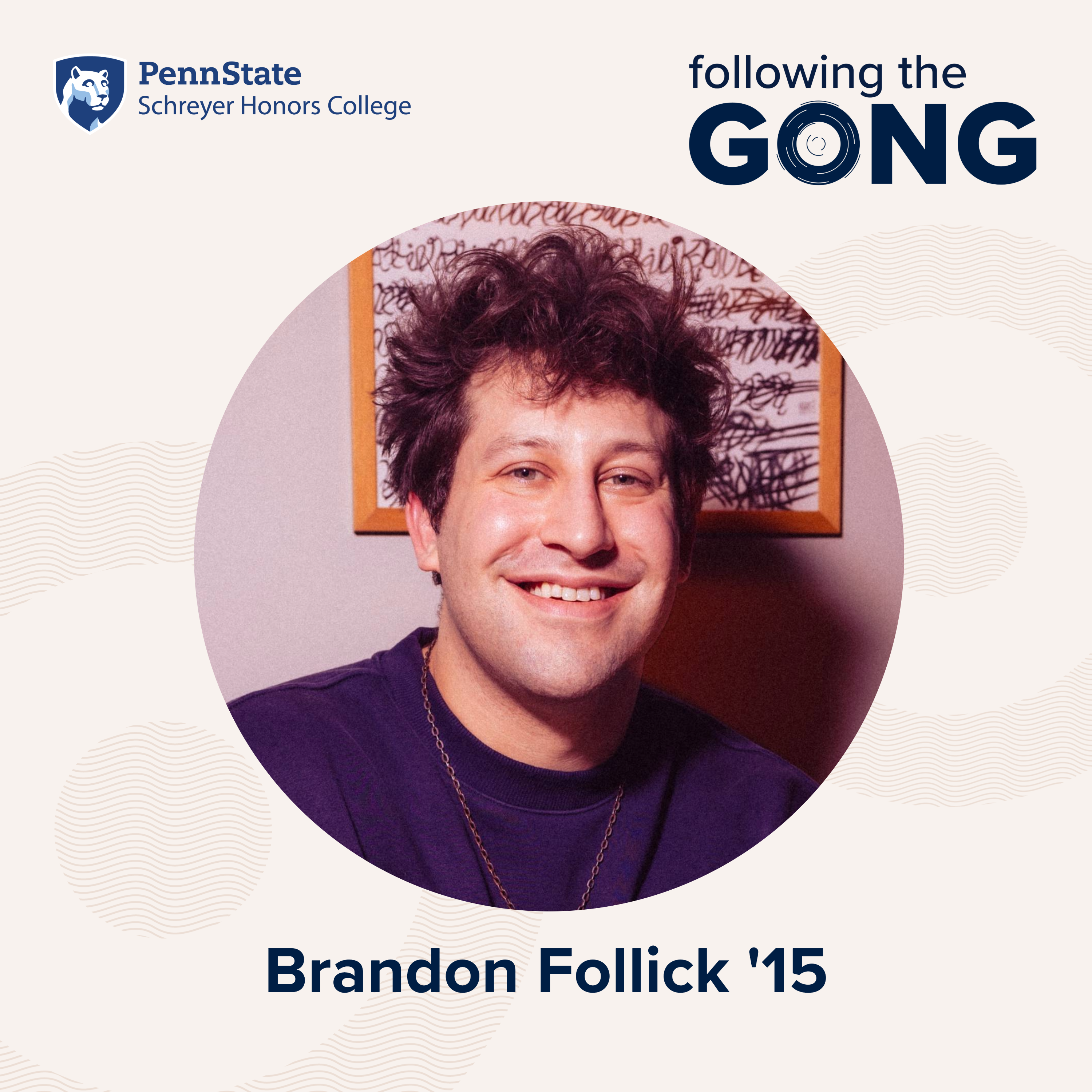
Welcome back to following the Gong, a podcast for Schreier Scholars, bringing you mentoring on demand from scholar alumni. I'm your host, Sean Goheen. And our guest today joining us in our studio, powered by the Peter Weiler family Endowment, is scientist turned writer and comedian, but still scientist Brandon follick, class of 2015. Brandon, thanks for joining us here on campus at University Park.
[00:00:31] Speaker B: Thanks for having me. It's been fun so far.
[00:00:34] Speaker A: So I have to say I've been doing this for a while, and your resume might have the most jarring switch from job to job in terms of the vernacular. So you have your comedy roles on there, and then you're talking about artistic productions and all the things that go into that. And then you have project manager, and you're talking about budgets and. And ROI and everything. And, like, does your life feel just a little surreal at times?
[00:01:00] Speaker B: Yeah, it's constantly dissociative. Yeah. I have to. I have to wear a lot of hats. I get to wear a lot of hats.
Yeah. It's interesting.
Well, I gave you the resume that kind of encompasses, like, my life, but I have separate ones for the audience. But I felt since this was like, a retrospective look at my life, then maybe I should give you the comprehensive version.
[00:01:21] Speaker A: Well, for that comprehensive, I do want to jump back to the earliest part of your story here and just talk about first, as we always do. How did you end up here at Penn State and at Schreyer as a student?
[00:01:33] Speaker B: Yeah, so I grew up in the Poconos area. I grew up in Stroudsburg, so grew up close by. Always familiar with Penn State, and I didn't discover Schreyer until I started considering admission to Penn State and I started doing a little more exploring. Exploring.
But, yeah, I don't know. I. I got in and, you know, amongst all my choices, like, it felt like the obvious one. Like, yeah, it. It felt easily navigable and, like, the best program.
[00:02:02] Speaker A: So if you're looking at all of the materials around this episode, clearly we're going to talk a lot about comedy. But what attracted you to biochemistry as a major?
[00:02:12] Speaker B: Yeah, I.
So I wanted to go to med school, and there's still time for that. But I. Yeah, I grew up with. My mom's a physician's assistant. My stepdad was a paramedic. Like, I grew up in. Around and hearing a lot about ERs and emergencies and medical medicine or emergency medicine.
Yeah. And I felt very, like, attuned with math and science, so it felt like the right choice for a major. And also hit all the pre med requirements, but yeah, and it still comes up in my life. It's a very valuable major to have, especially as you age and you have to start thinking about bodies and whatnot. And also since the pandemic, it was a very.
It was nice to have that information. I felt very prepared and like, knew how to absorb and communicate what was going on.
[00:03:04] Speaker A: So do you feel like it helped with like, your scientific literacy?
[00:03:07] Speaker B: Oh, for sure.
[00:03:08] Speaker A: You're saying.
[00:03:08] Speaker B: Yeah, yeah. Like, I never doubted the vaccine, you know?
Yeah. And even just like taking medications or like taking care of yourself or like knowing what's going on in the news, like, having that biochemistry background certainly helps.
[00:03:24] Speaker A: What's like, the nerdiest joke with biochem that you've ever written?
[00:03:29] Speaker B: Oh, my God.
[00:03:30] Speaker A: I.
[00:03:31] Speaker B: It's so hard to incorporate science into comedy. I.
I don't know if I've written a nerdy joke. It's so. It's so hard to like, one up those ones that have already been made about the periodic table. You know, it might come back to me in 20 minutes.
[00:03:46] Speaker A: This is a Shrier podcast. We're giving you homework. Your homework is to write a biochemistry joke for your next. For your next. Your next special.
[00:03:54] Speaker B: I'll send you a packet. Yeah.
[00:03:55] Speaker A: Awesome.
So obviously you did very well with your major. And what's study tips did you use to excel? Because biochem has a reputation as one of being one of the most difficult majors, even without the Schreier element layered on top.
[00:04:11] Speaker B: Oh, yeah. I mean, all my professors are great about office hours and being communicative over email and like, you know, giving attention and time outside of the actual lecture time.
I think also, you know, study groups.
I was really fortunate to like, make friends within my major, especially like within the honors bio majors.
So having that type of like, environment that like, not competitive but like, you know, really keeps you on your toes. Like every. You can, you can visualize everyone, like studying and like talking about what's going on in class. So that was certainly helpful. I was also a lab TA for a few bio labs, so I think the opportunity to like, educate and guide lab curriculum, like, certainly helped with my development of the information being taught in lectures, I imagine.
[00:05:05] Speaker A: Have you drawn on your TA experience in your career, whether, whether. Whether at Calliope or. Did I say that right?
[00:05:13] Speaker B: Calliope.
[00:05:14] Speaker A: Calliope or in your comedy career?
[00:05:16] Speaker B: Oh, definitely. I mean, yeah, the ability to talk to a room of 30 some people with some structure and some improvisation definitely helped propel me.
Yeah. And I think Also just the ability to be in a lab and see all the different tasks being done and all the different assays and keeping track of all that is the ability to supervise and multitask, especially in a lab setting, was huge.
[00:05:44] Speaker A: Nice.
I have to ask. So you did the TA thing. Great pig gig. Great opportunity to learn and develop those skills. But were you involved in any community social organizations, kind of those fun outside of the classroom leadership opportunities?
[00:06:02] Speaker B: Yeah.
So I was a finance director for. Moving On. Moving On.
So that's, you know, the student run musical festival that happens at the end of the year as a way of saying the seniors are moving on. Thanks for so much.
[00:06:14] Speaker A: It's been going on for decades, right?
[00:06:15] Speaker B: I know. Yeah. I. And I haven't been back since, but I would love to. It's still open to the community, right?
[00:06:21] Speaker A: As far as I know. Yeah.
[00:06:22] Speaker B: Okay.
[00:06:23] Speaker A: Definitely. It's what, typically like the last Thursday or Friday of the spring semester.
[00:06:27] Speaker B: Yeah. Like right before finals, which is fortunate and unfortunate.
[00:06:30] Speaker A: Hey, moving on committee, maybe you could have some opening talent here, but we'll get to.
[00:06:34] Speaker B: Yeah, you know, I just play the saxophone. I might pick it up for you guys.
And so I did that. I was involved in Science Lion Pride, which was like a student group associated with the Eberly College of Science.
Helped with a whole assortment of different tasks and student engagement. So I gave a lot of tours to perspective students, specifically science majors.
Yeah. And then I was in a variety of thon committees, which was a really fun way to meet people outside of my major and people in different years and whatnot.
[00:07:10] Speaker A: Awesome.
[00:07:11] Speaker B: Yeah.
[00:07:12] Speaker A: So I have to ask Brandon, this is a required question here on following the Gone. Tell us about your thesis and not just what you studied and what you researched, because I'm probably not going to understand the specifics, but also talk about how it's influenced your career both in biotech and in comedy.
[00:07:32] Speaker B: Yeah, I.
I worked in Melissa Rolls lab in the biochem department.
The lab studied neuronal development and regeneration after injury.
My thesis specifically looked at where mitochondria were located in developing sensory neurons, which is implicated with a whole assortment of different human diseases and disorders.
And it was very exploratory. I was essentially using fruit flies to knock out some genes and see if that really messed with their neuronal development.
Yeah. So I had a nice assortment of genes that may have been implicated in mitochondrial localization in neurons. And I joined that lab my sophomore year. It ended up becoming my honors thesis.
Dr. Rolls was great, a really wonderful advisor. She also Served as a reference to get my first and second job out of college.
Uh oh, should we acknowledge that or.
[00:08:38] Speaker A: No, something fell outside the studio. We'll investigate that later.
[00:08:42] Speaker B: Yeah, yeah, life goes on. But sorry, I didn't mean to lift the curve.
[00:08:45] Speaker A: Show goes on.
[00:08:46] Speaker B: Yeah, yeah. Dr. Rolls is a fantastic advisor and mentor. And part of that research ended up becoming a publication in the journal is called G3. And it's like some assortment of genes, genomes, genetics, all that.
So, yeah, I mean, that was like an incredible use of my time as an undergrad. And that also led me to my first and second job. So I was working with mitochondria and thinking about, you know, like, energy usage within developing neurons.
That led me to my first job. And I, you know, at some point at the end of my undergrad, I was debating whether I wanted to go to grad school or med school or something else.
Third secret thing ended up being comedy.
And so I got my first job as a lab assistant in a lab at Harvard Med, which is, I'm sure, thanks to having such a rigorous undergrad research experience.
[00:09:48] Speaker A: So walk us through your thought process of, you know, you're debating like, you come into Penn State, you want to go to med school. Originally you come from a family of healthcare providers, but then you settle on a research lab, probably intending more towards an academic grad school track.
What were the questions that you were asking yourselves or the discussions you were having with friends or family?
[00:10:13] Speaker B: A lot of it was just kind of reporting on what I was thinking and feeling at the time about what I wanted my career to be.
You know, I had.
Because I had such a wide net of, like, what I wanted to do. I did my best to seek guidance and, you know, shadow people in different departments and institutions. So, you know, I spent a lot of time around grad students and postdocs and principal investigators who were also lecturing classes here. And like, that seemed enticing to me.
I also shadowed some physicians and surgeons. I spent like a. I think the program still runs at the Lehigh Valley Health Network, but there's a research scholar program. So I spent a summer being introduced to clinical research, having my own summer project, and then also shadowing a cardiothoracic surgeon.
So I woke up many early mornings, went to the OR and watched a few surgeries from the perimeter of the room around 6am beautiful use of my time.
Yeah, I don't know, it seems so.
I think because I wasn't so assured that that was what I wanted to do, it felt like I was Just keeping my options open as a way to procrastinate, making a decision.
But you know. Yeah, you know, I was doing, I was thinking grad school, but then I was still taking the mcat and like I submitted a primary application, ended up withdrawing it.
Yeah, I don't know. And then I.
A few friends encouraged me to pursue comedy.
You know, I didn't do any comedy at Penn State. I didn't know we had like an improv club. No offense. Love you guys.
They have had me back at an improv festival. Love them.
Foley MO if you want to check them out. And yeah, I wasn't introduced to comedy at Penn State. The Upright Citizens Brigade theater sent a touring co and they did a show at the Hub my senior year. That was my first experience with improv.
You know, I used to take a copy of the Froth was like the student led satire newspaper. They would distribute it in the Hub every so often.
Yeah. And then, you know, towards the end of my undergrad, I still wasn't sure what I wanted to do. My friends were like, you are very funny. You should actually give comedy a go.
So the gap year also felt helpful for like giving me that space and freedom. But I always knew that I needed to have a source of income, so I decided to take night classes.
At the time I was living in Boston and it was improv Boston.
So I took a few improv and sketch writing classes and then my next job was in New York at a early stage biotech startup named Calliope.
[00:12:53] Speaker A: Yeah, I wouldn't ask about that because like early stage startup, that's like a whole gamble of an opportunity. And I think I remember, Tell me if I'm wrong, you were like employee 16 or I think 27 something. It was a really low number.
Yeah, yeah, like super low number on the, on the like onboarding list here.
[00:13:14] Speaker B: So yeah.
[00:13:14] Speaker A: What was that like going from, you know, Harvard Med, where I'm sure they've got resources out the wazoo.
[00:13:21] Speaker B: Oh yeah.
[00:13:22] Speaker A: To a startup with 20 some other people and you're bootstrapping everything.
[00:13:26] Speaker B: Oh yeah. I mean, and also that was like me leaving academia, like leaving a job in academia, which felt so familiar and comfortable to me. And like, you know, I had worked in a university before to entering the private sector and it was exciting. Absolutely. I mean, there's a lot of risk with startup culture, but you know, it was a very flourishing scientific environment. It was a little jarring to me to be like in a hybridized office and lab space, but it was a really good Experience to think about science as one department or entity within a larger business and start thinking about science less as a personally driven pursuit towards something and more of an enterprise.
I mean, I don't know how valuable it is, but it's definitely an experience.
But yeah, with a startup that small, you.
I am so sorry to use jargon, you do wear a lot of hats.
There's so many tasks that need to be done.
The actual workforce of the company is still growing.
It is a great opportunity to learn a lot of new skills and techniques and whatnot. And I was in a bit of a hybridized role where I was doing some operations, management and some lab work, which was. That felt more correct to me than.
[00:14:50] Speaker A: So you were like helping plan stuff, but you were also like getting your hands dirty, putting the lab gear on and.
[00:14:56] Speaker B: Yeah, I. Yeah. So my undergrad research was super valuable in thinking about genes and mitochondria. And so that led me to my lab at Harvard Med, which was involved in colorectal cancer metabolism, looking at mitochondria during.
In that disease model and using mice. And then that work in mice led me to work at Kalliope, which they study the gut brain axis, trying to uncover all the different components of that network, all the neuronal hormonal biochemical pathways to identify drug targets and develop those drugs. And I was helping to make mutant mouse models that didn't exist yet.
[00:15:43] Speaker A: Not gonna lie, I totally just pictured like a mouse wearing a magneto helmet.
[00:15:49] Speaker B: Yeah.
You know, you're not wrong.
Yeah, I know. Yeah. It's so funny to think, like, as a kid I was like, oh, a scientist just like makes a lizard glow in the dark every day and they.
[00:16:03] Speaker A: Some that might actually do that.
[00:16:05] Speaker B: Yeah, yeah, yeah. And they're valuable. And yeah, I don't mean to diminish their work. They're.
They're answering a lot of burning questions we have as a human.
[00:16:14] Speaker A: So you talk about the gut brain. Is that sort of like, you know, when your stomach hurts you kind of puts you in a foul mood because it's messing with your brain chemistry. Is that. Yeah, kind of like super layman's term, understanding?
[00:16:25] Speaker B: Definitely, yeah. I mean, the.
You have two brains, right? They're like, they're very centralized sources of communication that talk to one another by bidirectional pathways. But yeah, that's definitely.
If your tummy hurts and you're in a foul mood, I'm willing to bet a lot of money hangers are associated. Hangry, of course, happens every day. And I know better.
Yeah.
[00:16:49] Speaker A: Oh, my gosh.
So when you just recently left, we're recording this early 2025. So you just left your gig at Calio Bay. What was the size of the company and what was that like, watching the company grow over. What was it, like, seven or eight years that you were there?
[00:17:04] Speaker B: Yeah, I was there for eight.
By the time I left, I think There were around 100 employees. I want to say 96. That number feels.
[00:17:14] Speaker A: So you, like, quadruple, basically. Yeah.
[00:17:16] Speaker B: Yeah. And, you know, there's been a lot of ins and outs. It was a great space for recent grads to become familiar and get experience with lab research before going on to med or grad school.
It was a great space for a lot of people who were finishing up grad school or their postdoc to enter and use their specialties towards that space.
Yeah. And I, you know, as it grew more as a business, like, I. We also grew, like an accounting and finance and legal team and operations. So that gave me more people to learn from.
[00:17:54] Speaker A: Right. Yeah. Awesome.
So you have this day job and you have another job coming up soon. But, you know, can't quite share details yet on that. But you're. You're still a scientist by day. Yeah. But you also have this whole second life as a comedian and let's dive back and you kind of started to explain this a little bit. So you're at Penn State. You're getting just at the tail end, exposed to some of these things.
Like, what were some of those early, you know, did you watch SNL as a kid? Or, like, what? Like, like what were those first inklings and those friends who said, hey, maybe you should actually, like. No kidding. Like you actually should pursue something here. Like, what were. What was that like? Walk us through that earliest stage of your comedy journey.
[00:18:41] Speaker B: Yeah, I love television.
Watch a lot of those shows like Saturday Night Live. I watched a lot of the late night programs. Like, I used to love Conan and Dave Letterman. And I at the time, like, The Office and 30 Rock were like, airing premiered episodes. So I was watching a lot of those in high school. I love 30 Rock. I used to just watch it and be like, damn, I want to do, like, sorry, I want to do it.
Sorry, I didn't mean to put the letter E on this podcast. Now we'll bleep that out.
Yeah, I loved watching the character Liz Lemon. And I was like, I want to do that so bad. Too bad this is a fictional show. Didn't realize it was, like, completely based in real life. And then I. So I Kind of like let that interest stay dormant.
But then, like, as time went on, I started thinking more about these, like, actual people making those productions. And I looked into their careers in history. Wikipedia is an amazing free source, but you should donate. And I started to learn more about how they develop those careers, whether they, like, went to school for acting or writing or pursued improv or sketch writing at a local theater.
So that was the route I decided to go down, was in my free time, nights and weekends, started taking some classes. When I moved to New York, it was at the Upright Citizens Brigade Training Center.
Another amazing way to meet people and learn a lot of the tenets and foundations of comedy. But yeah, I think I just always had an early love for it. I love the movie the Producers. And I was really in love with Mel Brooks. Still am. Hi. And I hope he's listening to this.
[00:20:24] Speaker A: If Mel Brooks watched or listened to this, I think that would be peak. I think we'd have to cancel it after that. I think we'd do better.
[00:20:31] Speaker B: Yeah. I mean, I don't know. I don't think he's in alum, but you should bring him on anyway.
[00:20:36] Speaker A: Make special exception.
[00:20:37] Speaker B: Yeah, there's an amazing episode with him and Terry Gross for NPR Fresh Air. And he's got it. He's a good podcast guest.
Yeah, I think that Mel Brooks guy is really going to go somewhere. But yeah, I spent a lot of time performing and learning and I always, I felt like I wanted to do more outside of class and outside of shows. So I started to become familiar with like the humor and satire world.
I read the Onion as a kid and I was able to join later as a headline contributor.
A lot of these other websites take submissions like they.
Except full pieces that are written by people. So I started learning, you know, how to write like a humor piece.
Tons of workshops available, especially in New York from experienced and talented writers.
Yeah. So a lot of it was really like self motivated and exploratory, but it felt like the thing I always wanted to be doing.
Yeah.
Oh, sorry.
[00:21:43] Speaker A: So there's like, I have so many questions here around this. Like, you know, a lot of people who are in comedy, if they have a degree, it's probably like English or theater or maybe journalism even. You're coming at it with biochem.
[00:21:59] Speaker B: Yeah.
[00:22:00] Speaker A: So, you know, they might have had classes on some of those theoretical backgrounds, the history. So, like, where have you found that being the scientist has been helpful for you?
And where are some times where maybe it's been a bit of a challenge with all of those English and literature and theater folks.
[00:22:19] Speaker B: Yeah, that's a great question.
I've personally found it. I haven't had the opportunity to, like, really incorporate, like, my scientific experience and knowledge into comedy yet.
[00:22:30] Speaker A: Even just maybe your process.
[00:22:32] Speaker B: Yeah, I mean, there's definitely, like, a method and, like, a methodology to it.
Yeah. I mean, so, you know, I learned how to, like, write very technically as a scientific writer, like, writing papers, talking to other students when I had open office hours as a ta, like, so that was a very helpful skill for satire.
[00:22:55] Speaker A: Right.
[00:22:55] Speaker B: Because I, like, employs, like, the linguistics of another format to deviate from reality, make a humorous piece. So there are components like that that certainly helped, but I.
Yeah, I always felt a little drawn to biochem. Like, it. It. You know, it's life. It's.
I think it's really important to know how things work. Like, I remember, like, sitting in physiology lectures being, like, my mind was blown. I was learning, like, at 21, like, how my heart and circulatory system, like, really worked at a deep level.
I think it was really helpful for thinking about things at as deep of a level as possible, which is a lot of how I kind of operate in comedy.
I'm someone who, if I'm fascinated by it, I really want to know how it was made.
And I'll seek out people and learn their techniques, maybe find a way to speak to them and ask them about it.
And I. Yeah, I don't know if I would be able to be the same comedian that I am today if I did major in English or theater.
I, you know, been really fortunate to have the time to kind of, like, explore some of the, like, books and stories and plays and movies that a lot of these other majors are studying in their undergrad. In their undergrad.
But I think having a biochemist experience, like, certainly adds a different flair to comedy that makes me more unique or unique in a different way than the typical English or theater major.
But I love them nonetheless.
[00:24:33] Speaker A: Nice.
I think you made a really cool point, Brandon, about the. The technical writing and being able to, like, be judicious probably is the right. Is that the right word with your. Your word count and writing?
Is that something that you.
I guess. I don't know. Like, when did you realize that that was, like, something that was going well for you?
[00:24:57] Speaker B: Like, the.
What was going well, specifically?
[00:25:00] Speaker A: Like, being able to pull on, like, oh, my science writing is a plus here.
[00:25:04] Speaker B: Oh, interesting. Yeah.
I don't know when I really started. Probably, like, when I really started, like, doing more Humor writing, because.
And this is also how I kind of approach humor rating too, is like thinking about like the thing that hasn't been spoken yet or said and thinking about creative and original ideas. And I think a lot of that is parallel to what scientists do, which is, you know, we have a specific topic or field, but there, there's a gap in knowledge somewhere. So trying to uncover what is hidden in that gap. And as you kind of widen the network of like what we know scientifically, there's a lot of like original self driven pursuits being made by people who are devoting their lives to these studies. And I, that's.
I think being surrounded around, like being surrounded by those types was. Certainly has inspired my comedic Persona, I suppose, for lack of a better word.
[00:26:05] Speaker A: So what. How would you describe that? Because like, we've made references to kind of improv and sketch. There's humor writing, there's stand up. There's so many different forms that comedy can take.
So how did you start kind of learning the differences, the history, like, you know, both. Whether it was the things you've done on your own or these courses or workshops or community programs, like, how do you, how did you crash course yourself on. On this? Because you even, even at Penn State, you can't major in comedy necessarily.
[00:26:39] Speaker B: Yeah, we don't have that major yet.
Yet. And when you design the curriculum, you know where to find me.
[00:26:47] Speaker A: First honors advisor right here.
[00:26:49] Speaker B: Yeah, I think there is a satire human writing class here now, though.
[00:26:52] Speaker A: There's probably courses.
[00:26:53] Speaker B: Yeah, yeah.
[00:26:53] Speaker A: Not necessarily like a whole program. So. So like how do you piece together your own continuing education?
[00:26:59] Speaker B: Sure.
I think we're at a beautiful time in literature right now where there's a lot of books being written about the history of comedy. I remember reading a few of Mike Sacks books, you know, Keego Michael. Oh my gosh, what's his name?
[00:27:14] Speaker A: Keego Michael Key.
[00:27:15] Speaker B: Thank you.
[00:27:16] Speaker A: Penn State alum.
[00:27:17] Speaker B: Yes. He got his MFA here.
[00:27:19] Speaker A: Proud Nittany line.
[00:27:20] Speaker B: Yeah.
[00:27:22] Speaker A: And James Franklin, impersonator.
[00:27:24] Speaker B: Oh my gosh. Yeah, I forgot about that. Anyway, he wrote a book on the history of sketch that came out recently.
There are a lot of these sources that you can go to.
Yeah. Online history is another good way to look for how comedy has developed over time. I mean, there are people who have devoted a lot of their lives to studying the history and like anthological works surrounding comedy. And those are, those are kind of the spaces where I gravitated towards, like both as a comedian and just like kind of a curious mind, I guess.
Yeah. I mean, from a psychological perspective, like, the comedy is fascinating. Like I, you know, I love talking about like the meta objective stuff around it as well as like the subjectivity of a joke.
[00:28:12] Speaker A: What is the kind of comedy that you're like most naturally drawn towards, like watching or watching or contributing to. And it could be different.
[00:28:20] Speaker B: Yeah, lately it's been a lot of TV film. I've been really driven to learn more about like the actual digital production elements that go into it.
Especially like, you know, as technology advances, you know, we're hitting new milestones in terms of like how TV and film can actually be made.
I always wanted to enter it from the writing perspective. Like I, you know, since starting comedy, like I've always dreamed of like being in a television writer's room or you know, like having a screenplay made and learning more about those additional steps I find really fascinating. I recently took a few courses at like a local arts organization just about like sound design and like how to shoot B roll and how to produce and video editing theory.
I gravitate towards doors or towards those because I.
They're. They're art forms in themselves.
[00:29:13] Speaker A: Yeah, absolutely.
[00:29:14] Speaker B: Yeah.
[00:29:15] Speaker A: So that you actually segue perfectly to my next question.
So there's things like YouTube shorts and long form on YouTube, Instagram.
How are you seeing those places impact discovery and development of talent?
And what do you think the role of editors are when you have those kind of democratizing platforms like YouTube, Instagram, anybody can have a WordPress blog, et cetera?
[00:29:44] Speaker B: Yeah, that's a great question.
I think it's wonderful. I'm really glad that there are platforms like that where people have access to upload their creative works. I mean, like, you know, as much as I love television and film, like it is gatekept by industry members who like have their preferences and priorities and budgets and who they're willing to give money to and who they're willing to give airtime to. And like, you know, a lot of it has been very problematic in terms of like who's gotten an opportunity and who hasn't. So I think the ability to, for people to make more DIY productions has absolutely skyrocketed their careers when they should have been having careers and speaking with TV filmmakers in the first place. And I think it's really helpful to get your hours in.
So if you have the time and resources to do something like that. Just kind of workshopping how you work as an artist, not just in your material, but how your process and your method and your development, all that stuff is really valuable. And it's great that we have a product like YouTube for you to upload videos onto.
And, you know, like, the, like, the budget in Hollywood is in a really interesting place right now. Like, I.
There was a phrase going around last year, survive till 25. Just because, like, the economy in Hollywood is constricted so much, especially since the pandemic. Especially since streamers and then the writers.
[00:31:17] Speaker A: And the actors straight.
[00:31:18] Speaker B: Yeah. Which were a result of, you know, they struck. But it was really because of the way that streamers have manipulated or manipulated, like, guild contracts.
I hesitate to believe in technology has.
[00:31:32] Speaker A: Impacted the collective bargaining is fair.
[00:31:36] Speaker B: Yeah.
[00:31:37] Speaker A: Summarize it neutrally. Right?
[00:31:38] Speaker B: Yeah. For the most part, I mean, like, yeah.
[00:31:40] Speaker A: The.
[00:31:41] Speaker B: How ad spaces worked. Right. Has, like, really impacted, like, how TV is made and funded.
[00:31:46] Speaker A: Yeah.
[00:31:47] Speaker B: And I think those writers and actors should be absolutely compensated for the amount of work that they're that's putting out. And so that economy is kind of, like, transformed into, like, a gig economy and whatnot. So it's.
Hollywood is. And, you know, survive till 25. We get to 2025. The LA wildfires have, like, decimated valuable parts of the community. So I think the platforms like YouTube and Reels and shorts, like, those are fantastic ways for people to make DIY productions when we're not sure where the industry is going to go. And I think editors, which you mentioned earlier, as far as websites go like that, editors have a responsibility to make the tone of the website consistent and valuable and attractive to its readers. And, you know, I love when editors are willing to go very experimental with what they want to publish, and they're valuable writing mentors as well.
[00:32:51] Speaker A: Brandon, I'm going to be very pithy here. Comedy can be a mirror that you can hold up to both society and also to yourself in terms of analyzing the world around you, your own issues and insecurities.
Where do you mind for jokes and what is off limits for you? Like, where ethically is your stopping point of, like, this is as far as I'm willing to go. And nothing past this line is funny.
[00:33:20] Speaker B: Oh, man. Yeah. Great question. I.
Where do I go to for jokes? I like to observe human behavior. I like to, You know, a lot of my comedy is rooted in, like, satire and parody, which relies on being able to mimic what I'm seeing out in the world. So, you know, like, a lot of, like, really problematic people. Like, I want to be able to, like, make commentary or, like, satirize what they're doing to illustrate a point that, you know, mainstream society might not Be saying not to be like, I'm so alt. But I. Yeah, I am looking towards those things. Like, I'm looking at, like, how our government treats people and, like, how businesses treat their employees and people outside, like, their customers, you know, like, how technocrats are, like, manipulating the economy and our government. So there are things like that on the macro level. And then I'm also looking towards, like, you know, how is this straight guy treating his girlfriend?
Like, how is his husband treating his wife? Like, it's things like. And then, like, how are these kids treating their mother? Like, I think I'm looking more towards, like, the people who don't have full equal access to power and autonomy and trying to use my comedy more towards highlighting those moments in our life.
Yeah. And then there are some internal flaws within me as well that I love to highlight, too, because I think the sign of good art is transmitting what goes on in, like, your psychological interiority out into the world.
You know, every. Everyone's so fascinating. Unique language is so limiting to, like, what we can actually communicate with each other. I think art evokes more than words can.
That's what I really aimed towards. What was the second part of that question?
Sorry.
[00:35:16] Speaker A: No, you're good.
Kind of like, where is. Like, what are you not willing to.
[00:35:22] Speaker B: Oh, yeah, where's your.
[00:35:24] Speaker A: This is the honors College Ethics is a huge part of our culture here for our scholars, our alumni. So where is the stopping point for you of where it's no longer funny?
[00:35:36] Speaker B: Yeah, I think the concept of punching up and punching down here absolutely applies to this question.
[00:35:44] Speaker A: Yeah, explain that.
[00:35:45] Speaker B: Yeah. So punching up and punching down is the relative direction of your joke from your status and your identity towards the target of the joke.
So, you know, you think about things like your racial identity, like socioeconomic class, class in general, like just your status in a power system and in a hierarchy and thinking about the target of your joke and thinking about whether you're actively normalizing a culture that oppresses people or commenting on the oppressor who's making that culture that's so oppressive for people.
[00:36:19] Speaker A: And.
[00:36:20] Speaker B: And so I. I think really critically about those times. Obviously, I never want to punch down.
Yeah. Like, I, you know, I think what, like, Dave Chappelle does towards trans people is, like, absolutely heinous. I mean, it's such a poor use of his career.
I don't think he's going to listen to it. He might. He might.
[00:36:41] Speaker A: Who knows?
[00:36:42] Speaker B: Yeah, him and Mel Brooks. I.
Yeah, it's just.
It's places like that where I'm not willing to. Where it feels harmful and oppressive to someone who's already suffering so much from a system that, like, inherently I benefit from. Like, those are the moments where I think comedy isn't that, like, that won't be the comedy for me.
I also really try to protect people in my private life. Like, I really don't like making fun of, like, my family and friends. Like, I.
Like, I'm a child of divorce, but I'm not gonna, like, talk about how. Whatever, you know, Like.
But what do I want to say with that? I. I.
[00:37:26] Speaker A: Cause there's comedians who, like, throw their partner under the bus as, like, half their act.
[00:37:30] Speaker B: Oh, totally. Like, you know, there's so many guys who go up there and talk about how much they hate their wife, and it's like, what would you do if your wife is in the audience, like, knowing she might be? I don't know. But I.
It also impacts my relationships with those people. I never want our relationship to be fodder for my artistic pursuits. I think there are better things I could be talking about than what my boyfriend is going through, and it also manipulates the trust that people have in me. I value my relationships with my friends and family more than is my Tom Brain in this.
[00:38:04] Speaker A: Is this right enough in his fit?
[00:38:06] Speaker B: Yeah. No, truly. And I have that boundary with comedy where I'm like, I'd much rather have, like, a authentic connection with people in my life than a vapid career in comedy.
[00:38:19] Speaker A: So talking about some of these things, you made me think, like, there's probably parts of your identity where you're very much majority privileged, but then there's other parts where you are in the more historically marginalized or oppressed category. So how do you balance that? And especially thinking about some of the programs that you're involved in with. With, like, the Onion and Reductress and some of the other things on your resume.
[00:38:40] Speaker B: Yeah.
I think it's really thinking critically about the target of your joke and, like, who you're working for and who's benefiting from it.
Yeah. Like, I. I try to remain sensitive to my material and my work constantly. And thinking about my audience and thinking about who's not in my audience, like, how. How will this joke age in 5 to 10 years? Right.
And with places like the Onion and Reductress. So I think what you're referring to is this program. I don't know if I can say it, but it's. It's called Diverse af.
And essentially what we do is we create a Writing workshop series that are taught by staff writers of the Onion to people who belong to backgrounds that have been historically excluded in entertainment to help them begin or develop their comedy career.
And the Onion is an incredibly valuable place to be associated with.
I realize I'm using the word amoled, which is good, good for an audio format, I think, and very. Yeah, yeah, yeah.
I, I'm in a place in my life probably due to factors that I've decisions I made in, factors that are just inherent to life. And I really want to utilize that to make opportunities for other people because it's lonely at the top. No comedy can be so isolating, but it's also the places where I've felt so connected to other people in community. So I've seen how like, comedy has transformed people's lives and I just making it and enjoying it. So I want to be able to do everything I can to make those opportunities accessible to people.
[00:40:39] Speaker A: So when you're talking with folks in those programs or maybe aspiring comedians generally and thinking about scholarship, maybe they want to take a less traditional career path overall, what advice do you give them? Because, like, I imagine that there's times when you get reactions when you say, oh, I also am a stand up comedian. And you might get, oh, that's so cool. But then you also get. People are like, oh, seriously, you're. Wait, like, how do you make any money doing that?
[00:41:04] Speaker B: Yeah.
[00:41:05] Speaker A: So like, what do you say to folks who want to pursue those artistic endeavors or even, or even investing in a startup or things that are risky and not the safe bet? Like, what is the advice that you give when, when that comes up?
[00:41:17] Speaker B: Oh, gosh. Yeah.
[00:41:19] Speaker A: How do you respond to the haters?
[00:41:20] Speaker B: Yeah. And there's so many of them now. I.
Nourish yourself, Stay practical with your decisions. Like I, you know, focus on your livelihood before doing something like comedy. And like, I, like for me, it always felt like if I, especially towards the undergrad, I was like, if I don't do this with my life or if I don't even give it a try, like, I'll spend the rest of my life wondering like, if I would have been any good at this and also if this would have been my life. If it's like, think about it as like, if you live in a world where you can't fail at anything, what is the one thing you would be doing?
So for me, that felt like actually it wasn't even stand up at first. It was TV writing and just writing comedy in general. And then that led to stand up.
Cause, you know, it's nice to look up from your phone sometimes and be in a room with people experiencing a collective moment.
And I totally understand, like, where we are in society. And, like, people need to earn an income and a living and also have community, friends, family partners, pets. And I have a corgi at home, so I'm speaking directly to her.
[00:42:39] Speaker A: Yeah.
[00:42:40] Speaker B: And if it feels like too big of a daunting thing, then reevaluate your first step to make it the most practical thing and build towards something. It's so hard to have, like, a to do list with your life, but it's so much easier to think about the person you want to be, and that's the thing to aim for, rather than just achieving little tasks along the way.
[00:42:59] Speaker A: Awesome.
So, Brandon, thinking about scholars who are interested in creative pursuits, whether comedy or similar, or what are some of the skills or experiences that they should be prioritizing now or maybe when they have some free time, once they're out in the. In industry or in grad school, once they're done at Penn State, to have success like you've had.
[00:43:22] Speaker B: Yeah, I. You know, one thing that Schreier is really helpful with during my time as an undergrad was, like, encouraged me to be very, like, have different networks and experiences and, like, be managing different involvements at any single time. And I think the ability. Like, having the ability to have so many different facets of your life because Shreya encourages you to go out there and join the various clubs and learn from different mentors.
Incredibly helpful as an artist, I think just being inspired from different places to pull from and people to connect with.
I think specifically as a comedian, it's helpful to think about, like, how you're connecting with people. Like, stage fright was like, you know, like, growing up, I was, like, in the pit orchestra in the musical. I wasn't in the musical. I was on stage. Yeah, yeah. You get it. And I mean, we're the people that make the magic happen.
[00:44:12] Speaker A: It's a team effort.
[00:44:13] Speaker B: Yeah, yeah, yeah. You little altos and tenors keep singing, but it's the people in the back wearing black who are really doing something.
[00:44:21] Speaker A: They push the sets out on stage.
[00:44:22] Speaker B: Oh, yeah. Striking chairs. Yeah.
Building and painting that set. Yeah.
Never overlooking the work of someone else. It's huge. As an artist, being so thankful, it's so hard to get anything made. So anyone who's involved in those types of productions, my heart goes out to you. Thank you so much for all the work that you do.
I've Been watching the Muppet show recently, so I'm thinking a lot about all the people and puppeteers involved in that.
The Bernadette Peters episode is incredible. Just watching that one recently, I.
What else is a scholar?
[00:45:00] Speaker A: Sounds like being a T.A. probably, if you have a chance. Not a bad idea.
[00:45:04] Speaker B: Yeah, I mean that was a really good way of just like not only learning how to speak to people in public like that, to an audience and being attentive to what's going on and how they're reacting to things. Because a lot of comedy is responding and labeling what's happening in our world, but also the ability to like really sync with the material itself and be able to teach it and like be able to paraphrase it in different ways. For people who absorb information differently than others, I think is a really helpful tool as an artist because you know, when anyone starts out like they're not making their magnum opus and they're like masterpiece, like if they do, they're really striking luck. It's not some.
[00:45:45] Speaker A: It's all downhill from there.
[00:45:46] Speaker B: Yeah, true.
Yeah. A little bit of a one hit wonder, but I continuing to develop your material, like taking in feedback, what feels helpful and what doesn't is huge.
And I'm trying to think specifically more of what scholars can be doing, talk.
[00:46:06] Speaker A: More about the feedback.
How did you learn to take feedback on your material and not take it personal?
[00:46:15] Speaker B: Yeah, it really depends on what I'm seeking feedback from. Sometimes I'm sharing a writing sample with a friend and they might not love the thing that I love the most or they might tell me to cut a joke and I'm like, but no, I need that there. It's my emotional support joke.
They say kill your darling sometimes and that material can always come back in a later form. A lot of my stand up is just like sometimes just rejected headlines from the Onion that I was like, I am too in love with.
[00:46:49] Speaker A: I'm in charge. Yeah, true.
[00:46:51] Speaker B: I'm my own editor. I.
Yeah, feedback is feedback. People are going to respond how they respond. They're going to be wearing different hats. Sorry to use that phrase again. Using different perspectives, looking at things with various lenses and like their life experiences. They're looking for things that feel intrinsic to them and they're missing things that are new to them and they don't have that like internal that encompass for yet.
So feedback is very. Take what feels useful to you and shelve the rest of it because maybe it'll be useful for you later.
And it's interesting too because like Sharing, writing, you do that and then there's like a wait time. Doing standup is so instantaneous.
Going to open mics and shows and whatnot. Like you get an instant audience reaction and sometimes audiences react differently to the same material and it might just change on the delivery or how the room looks, what you're wearing that day, how they're feeling, like what's going on in their lives. Your gut health. Your gut health. Yeah, yeah, they're hangry. Hopefully you're doing a show at a.
[00:47:51] Speaker A: Place that serves food.
[00:47:52] Speaker B: But I.
Feedback is valuable. It's how you engage with other people. It's how you.
It's the thing that differentiates your art from. From existing or being in a vacuum.
[00:48:09] Speaker A: Yeah.
[00:48:10] Speaker B: But not all feedback has to be utilized.
[00:48:13] Speaker A: Gotcha.
Brandon, you've. Comedy can be delivered in so many different places. It could be in a club with 10 people in the audience. You could be in a multi hundred seat theater. You could be in a black box theater. Could be on camera Pre recorded for YouTube.
Where do you, like, what are those different experiences? Like how do you navigate? Which is the most intimidating for you and how do you overcome that stage fright that you talked about?
[00:48:41] Speaker B: Yeah, I am.
The most intimidating thing I think to me would be being in a room of 2,000 people. There's a camera on and then only like two people watch it. That would suck. And no, it's different. I mean it's the way I approach it is like I love connecting with an audience and talking about like the instant moment that we're all experiencing at the same time.
So that really depends on like how I'm gonna talk to them. How I talk to 2000 people is gonna be different from how I talk to two people. And it's two people. That's a, that's a conversation. And I'm a little willing, I'm more willing to share the mic around than I would with a 2000 person audience.
And it, it's. Those audiences are a nicer challenge to connect with because, you know, everyone has a variety of different experiences. Experiences. Not all your material is going to resonate with everyone. That's been the hardest thing for me to learn is like, yeah, you can't make a joke that's going to make the entire world laugh. Like some people just won't get it or won't like it.
And it's. Yeah, how you engage with them will absolutely differ. Like I'm not going to talk to a room of 10 people as if we are in a full arena. Like I'M going to talk to them like I'm just another person in the room and that we're sharing that moment together.
And then if I am in a stadium or arena with a variety of people, I don't have that luxury of getting to connect with everyone so intimately.
But that's a very cool moment. I mean, like, yeah, projecting, trying to operate larger than life.
Aim for the bleachers, aim for the nosebleeds.
[00:50:21] Speaker A: When you do watch the ERAS tour and try and take notes.
[00:50:23] Speaker B: Yeah, yeah, yeah, yeah. I'm just sitting there, like, unmoved by her, just taking notes.
I know. I remember watching like Robin Williams and he would, like, he's delivering those jokes to like the rear mezzanine. And that's what I really.
Yeah. So like, in those types of environments, like, if you're hitting the back, you're like everyone else is in the middle. Like, you're, that's how you're really, like making a collective, I think is. And making sure everyone in the room feels present.
[00:50:52] Speaker A: Awesome. I think that's good advice for a lot of other things besides just comedy.
[00:50:57] Speaker B: Yeah. Try not to exclude people.
Yeah. Create inclusive environments.
[00:51:02] Speaker A: Punch up, not down.
[00:51:03] Speaker B: Punch up, not down.
And yeah.
Try out the material and see. See how it lands.
[00:51:12] Speaker A: So, Brandon, I am not a scientist. I'm not a stand up comedian. As much as I like to think I'm funny and I'm straight. So, like, there's a lot of things that I don't have, which is valid.
[00:51:22] Speaker B: It's totally fine.
[00:51:24] Speaker A: So these are just my, that's who I am and these are my, my identities. And so I can't speak to those things, but you can.
So what are the things that I should have asked about in our conversation before we go to our wrap up questions that, you know, you get questions from your workshop participants or from your interns at your company or mentees or friends that we should have talked about.
[00:51:49] Speaker B: That's a great question.
I don't know. I'm trying to think of, like, the conversations I have with people just about, like, balancing those things in my life.
The one question I ask myself often is, like, what will you do if, like, comedy doesn't work out? Like, what if there is no longer, like, an economy for entertainment? Or like, what if we start living in a society where, like, comedy doesn't feel as important?
I don't know.
Then I'm gonna pick up my med school application again and really give it a go. And I am trying to think of the other things we have.
[00:52:26] Speaker A: Well, at Least you did the bedside manner knocked out.
[00:52:28] Speaker B: Yeah, true.
Yeah. People on their deathbed would probably love me doing little bits around them.
I can't imagine anything more heinous. Oh, my. That's a whole other, like.
[00:52:40] Speaker A: Yeah.
[00:52:41] Speaker B: Another way that I operate is, like, if something bothers me or someone's bothering me, I'm like, am I gonna even think about this on my deathbed? And if I am, if I imagine myself just, like, so angry or whatever, I'm like, I'm gonna resolve this now and then sometimes I could just brush things off. But what else? What else have we not discussed?
Boundaries, I suppose. Like, I really try to.
I. I've had this a couple times with like, even, like, interviews and recruiters. Like, you can Google my name and learn my career. And, like, there's no way of me hiding, like, what I do with my free time because a lot of it requires me to be public. So they ask, like, how you balance it. And, like, I really try devoting, like, my hours to the thing I'm doing. And, like, I. I think, oh, I was gonna bring this up with this. What should Shrier scholars be doing? Compartmentalizing. Compartmentalizing is huge.
Having boundaries isn't like it. It's not a negative. It helps you focus on the thing at hand.
And that's.
[00:53:41] Speaker A: If you're at the lab, you're at the lab.
[00:53:42] Speaker B: If you're at the lab, you're at the lab. You're at the bench. You gotta pipette that solution somewhere.
It's decaying over time.
[00:53:49] Speaker A: You don't wanna be using the eyewash thing.
[00:53:51] Speaker B: Yeah. Oh. Oh, my gosh. Yeah, I had to.
Yeah, I've had to use that before.
[00:53:59] Speaker A: Safety first, kids.
[00:54:00] Speaker B: Yes. Wear your goggles, coats, pee, pee, all of it.
[00:54:04] Speaker A: Closed toed shoes.
[00:54:06] Speaker B: Closed toed shoes. That's a huge one. Yeah.
You know they say don't wear skirts and shorts in the lab. It depends on what you're doing that day. That's how I feel. Sometimes it's hot outside trying to think what else we haven't covered.
Yeah.
You know, the way I talk to a room, like an audience, is not the way I would talk to my boss. So, like, being very appropriate and professional at work.
[00:54:36] Speaker A: Know your audience. Yeah.
[00:54:38] Speaker B: Know your audience.
Absolutely. No. No bits at the CEO.
Unless it's their personality. Unless it's like, one of those funky startups.
[00:54:48] Speaker A: Of course.
[00:54:49] Speaker B: Yeah.
And anything else, feel free to reach out to me.
[00:55:00] Speaker A: So, Brandon, this is your chance to brag. What would you say is your biggest success to date? In your career or in life?
[00:55:08] Speaker B: Oh, man. Being here.
No. It is nice to come back, Pete.
[00:55:12] Speaker A: You've been on following the Gone. It's all downhill from here.
[00:55:16] Speaker B: Yeah.
This is the end of my career. I made it.
I don't know. What's the biggest achievement tip?
[00:55:22] Speaker A: Many of all of your hats that you wear.
[00:55:23] Speaker B: Yes. Thank you.
My biggest achievement.
I don't know, I.
I can think about what would be my basic achievements. Like, I would love to egot. I would love if someone came up to me, like, later in life and it was like, I started comedy because of you. Like, that would be huge to me.
[00:55:42] Speaker A: I thought you were gonna say winning an egot, like, just sweeping.
[00:55:45] Speaker B: Just out. Yeah. I mean, if I could accomplish it in one year. Like, if you have the right project and you're looking to hire someone who wants an EGOT in one year, I'm so willing to devote my time and energy to that.
For your project, not for my personal gain.
What's my biggest achievement?
I think, you know, I helped contribute to, like, a book that was on a list of, like, the funniest books of the year. So that was really huge.
One of the websites I write for reductress.
The editors and a selection of contributors wrote some pieces. The book is called how to Stay Productive when the World is Ending.
It's a bit of a satirical self help book for the.
For the working force. And yeah, Vulture put it on its funniest books of 2023. That felt really great. Honestly, like, having my words printed somewhere has been huge.
[00:56:39] Speaker A: Nice.
[00:56:41] Speaker B: I've written some pieces with my best friend, Reema Parikh. We've gotten published in the New Yorker's humor section together. Like, that also feels like a great achievement to me personally, just to be, like, immortalized on the Internet with my friend.
Yeah. And.
Yeah.
And whatever Mel Brooks has said about me. Whatever. Mel Brooks. My biggest achievement.
[00:57:01] Speaker A: Yeah.
So on the flip side, though, what would you say is the biggest transformational learning moment or mistake that you've made in your career? And most importantly, what did you take from that experience that maybe others could learn from?
[00:57:16] Speaker B: God, I.
Huh. It could be any point in my career or like, post.
[00:57:21] Speaker A: It could be a student at Penn State. It could be yesterday.
[00:57:24] Speaker B: Yeah, I.
I mean, I always go back and forth if I should have changed my major, but I think having, like, my major is what gave me the experiences that let me know who I am today.
Biggest mistake or regret.
[00:57:43] Speaker A: Maybe the time you had to use the eyewash.
[00:57:45] Speaker B: Yeah, I mean, that was.
And I can probably talk about it.
Yeah, I think the statute of limitation is passed.
Yeah. I had a student who was making an agarose gel in a lab, and the gel requires you to like, microwave a liquid and then pour it into like, this plastic container where it then solidifies.
And he was up all night studying for a chemistry exam that day. So he, like, had his face really close to the plastic container and poured in. Some of it splashed into his eye. And the gel also contains a carcinogen, so he had to use the eye wash station.
[00:58:29] Speaker A: So.
[00:58:30] Speaker B: Yeah, I mean, that didn't feel great.
[00:58:33] Speaker A: Of course.
[00:58:36] Speaker B: Yeah. Study ahead of time. Obviously. Don't pull any all nighters if you can maintain that.
And safety first. Yeah. Oh, keep detailed records of everything.
Yeah, I mean, there are so many components in my life where I just like, I wish I photographed that or recorded, like, I wish I journaled more in college so I could mine some of that material.
[00:58:59] Speaker A: Yep.
[00:59:00] Speaker B: But yeah, one thing I. And I, I did this recently where I like, went through my college emails because I've had it forwarded to my Gmail, which also contains my papers and whatnot that I've like, emailed to people. And like, that stuff is so humiliating, but ultimately, like, really valuable just to kind of like keep markers of who you've been and where you're at now.
But yeah, wish I journaled more.
[00:59:27] Speaker A: So one thing we haven't talked too much about is mentorship.
Talk about mentorship both in the STEM side of your life, but also the comedy side. How do you get mentors in those spaces? And then also how do you pay it forward?
[00:59:39] Speaker B: Yeah. You know, there are formalized systems. Like, you know, like, I remember, like, Penn State, like, having an opportunity to like, pair you up with a mentor who.
[00:59:50] Speaker A: Mentoring with honors here in the Schreyer Honors College.
[00:59:52] Speaker B: Oh, nice. Yeah, yeah, sorry. I should have. I should have promoted it more.
[00:59:57] Speaker A: Not so shameless Plug specifically.
[00:59:59] Speaker B: I wasn't aware of the title.
Yeah, Fabulous formalized system. There are definitely ways like that.
I think as you start to enter the workforce, like your supervisor or like more mature member of another team might serve as a mentor. Like, my supervisor at Harvard Med was a former Shrier scholar. Actually, it's what helped get my resume airlifted out of the pile of people who were begging for that job. She was another biochem major at Penn State, was in Schreier, went to MIT for grad school and was working as a postdoc at Harvard Med. And her grant allowed for a research assistant. So I was her research assistant. She was a fantastic mentor. And then when I went to Calliope, who was that?
[01:00:45] Speaker A: If you want to give a shout out?
[01:00:46] Speaker B: Sejal Vias, I believe she's an editor at a publication. I haven't talked to her in a while, but little shout out right there. Yeah, yeah, yeah. She was fantastic. I'm sure she continues to be fantastic. I'll use the present tense. And I've had a rotating cast of supervisors at Kaliope who are wonderful, and I'm really excited about my new job where I'll get to learn from new people who have new, valuable insights to share with me. And I think with comedy, like, you know, that one is so much more, like, attuned to who you are as a person rather than, like, who you want to be. I mean, there are, like, workshops and classes you can take with people to, like, go out of your way to get the types of insights that you're seeking from that person. But with a mentor, like, it really is about, like, you know, going to open mics and shows and then, like, sticking around afterwards and like, befriending people, but not doing it in a way where it's so overtly, like, you're trying to use someone. Like, I think there is, like, a nurturing component to both.
Like, anyone I've helped in comedy, it's always like, oh, I'm doing it because I wish there was someone in my position doing this for me when I was, like, at that stage.
And vice versa. Like, you never know, like, who you're going to work with in a few years. So always be kind to people. Always be helpful and attentive and communicative.
Yeah, the comedy mentor thing is, like, so much more ambiguous and, like, subjective than the formalized systems like the scientific workplace.
And ask around if you, like, don't have access to, like, a mentor that feels. Feels correct for you. Like, I remember when I was at Harvard Med and I still wasn't sure about comedy. Like, I considered going into, like, journalism for scientists, and there are a few master's programs that specialize in that, but they're pretty few and far between. And Sejal had a former classmate in grad school who pursued that field and connected me with her. So I emailed her back and forth and, like, that was valuable. Like, sometimes your mentor is just, like, have valuable connections too, if they don't have, like, the specific insights or, you know, tangible, deliveral deliverables that you need.
Same with comedy. Like, yeah, so much of it is also who you know. So, like, it's Good to know people and connect with people and support their work. That's another way of finding mentors.
Yeah. Awesome.
[01:03:20] Speaker A: So we mentioned Sejal. Is there anybody else from your Penn State days that you want to give a shout out to here? Thesis Advisor friends?
[01:03:29] Speaker B: Yeah. Dr. Rolls, who is my advisor in the undergrad lab.
Really spectacular, helpful woman.
Many, many people have participated and worked in her lab, and their careers have only flourished as a result.
I.
Oh, my gosh, I am blanking on her name. Her first name is Pamela.
She taught an honors course here. And she was also like a really.
She really helped develop a lot of my confidence as a. An academic because we. I took a class that was. It was a psychology class, was focused on India. I don't know if it's still available. And I use science in, like, I leverage a lot of, like, some of my scientific knowledge into a paper about malnourishment occurring in India. And like, she was so helpful in, like, commenting on, like, the multidisciplinary work that I was doing in that paper. And I was like, oh, yeah, you can really, like, synthesize and hybridize a lot of your experiences and knowledge to, like, one pursuit, which obviously, like, I may have been doing, I'm sure many people are doing, but it was so nice to just kind of have that so, like, articulated as a compliment.
I've had some amazing friends that I've gained here at Shrier too. Like, Taryn Zurman is another Schreier alum. She majored in biotech, went on to grad school, is a doctor now works in San Diego.
Brett Turner, environmental consultant at Endeavor. These are like my best friends from Schreier years. I like. I'm still friends with them.
Shirley, Lou and Alina Auerbach, also scholar alum, live in New York. Really fascinating careers.
[01:05:20] Speaker A: Yep. Elena's been a past guest on here.
[01:05:22] Speaker B: Yes, I saw. Yeah. Elena's.
Elena's wonderful.
[01:05:26] Speaker A: Yes.
[01:05:29] Speaker B: I have so many nice things to say about her, but this episode does need to come to an end at some point.
[01:05:34] Speaker A: Yeah. So I did want to ask your fun fact was a standout for me on the questionnaire about an experience you had as a child. I just wanted to give. You kind of alluded to this.
[01:05:47] Speaker B: Yeah.
[01:05:49] Speaker A: With what you do. And don't mind for jokes, but I want to give you the space to just share this anecdote because it was too cool.
[01:05:55] Speaker B: Thank you. Yes. So my fun fact is that my divorced parents custody agreement of me was decided by Judge Judy before she was television's Judge Judy. She was my Judge Judy. She was family court Judge Judy.
I was born in New York City, where I live now, and I grew up in Stroudsburg. But, you know, for our sake, just think of me in Manhattan. And my parents divorced soon after I was born, and an altercation between them resulted in them returning to court to have custody resettled, and that was presided over by Judge Judy.
My mother has told me so many tales, like, of this case, like, she was just as terrifying in person before she was on tv as she appears on screen.
Yeah, yeah. There's, like, a quote that my mom says often where, like, I think my father, like, was speaking out of turn or something like that, and Judge Judy said something that was like, I have yet to do a psychological evaluation on you, Mr. Follick.
And I.
You know, my last name is also Follock, so that. That has always felt resonant with me. I didn't get to attend. My uncle was babysitting me while my parents were away, and I obviously wish I got to be present for that. But Judge Judy has shaped so much of my life since her involvement in my family, and I would love to meet her someday.
[01:07:25] Speaker A: It feels divine that you went towards comedy. It feels predetermined, almost.
[01:07:30] Speaker B: Yeah. I've had a lot of stuff to say about what's occurred in my life.
Yeah, totally.
[01:07:38] Speaker A: Your dad getting called out by Judge Judy.
[01:07:40] Speaker B: Love it. Yeah. Yeah.
And my mom just terrified of her. But I think if they had hung out after the case, maybe they would have become friends, because they do feel pretty similar.
[01:07:51] Speaker A: So, Brandon, as we're wrapping up here, what's, like, a final piece of advice that you would leave with our scholars?
[01:08:00] Speaker B: I remember.
Okay, so I spoke on a panel at the Connect event.
[01:08:05] Speaker A: Yep.
[01:08:06] Speaker B: And I was in a room with some individuals, and it was like, the. The discussion was.
The topic was, like, starting a career, like, when you're not in, like, a cookie cutter type setting.
And I was in a room with some individuals who were older than me, and a lot of their advice to the younger generation was, you know, start a business and then sell it. And like, that just like.
I mean, it sounds so beautiful, so poetic and philosophical, and I don't mean to discredit them at all. Like, I.
They worked very hard for those accomplishments.
I just don't know if, like, current scholars exist in an economy that, like, is so fluid and accessible to them like that.
You know, so much of it is survival mode and whatnot, but things do get better over time. And I mentioned this before, but, like, I think when it's the big things like that.
Okay, two pieces of advice that stem from that. When. When it feels like a big, looming, daunting task ahead of you and it feels unachievable and inaccessible and undoable, your first step is probably too big. So reel back and make a smaller first step and then make a second step that's bigger than that. Like, make them digestible, bite sized tasks or accomplishments that you can achieve. And also aim to not just do, but to envision the person you want to be and aim towards that rather than like aiming yourself towards the thing to do or like the program to be in or like the community to be in. Like, think about the person you ideally want to be and do what you can to be that person.
[01:09:48] Speaker A: Awesome.
How do you eat an elephant? One piece at a time, right?
[01:09:54] Speaker B: Oh, man. Someone said it first.
So poetically. Should I cut all this? I can come up with other advice.
[01:10:01] Speaker A: No, hydrate.
[01:10:03] Speaker B: Hydrate's always great.
[01:10:04] Speaker A: Yeah. Sunscreen, skin. It's important.
[01:10:07] Speaker B: Oh, yeah. Don't use that same eyes apricot scrub. I use that stuff as a kid and I'm still recovering. Yeah. Yeah. I might as well pick up smoking now.
[01:10:19] Speaker A: Kids don't smoke.
Brennan, how can scholars reach out if they want to connect to you? Like, what are the best avenues for that?
[01:10:25] Speaker B: Yeah.
[01:10:26] Speaker A: Or also follow your work.
[01:10:27] Speaker B: Yeah. As I mentioned earlier, I have a crazy online digital footprint.
You can find a lot of my contact information there.
I am on Instagram. You could just look up Brandon Follick.
My email is my first and last name at Gmail. I don't know if I worded that in a way that's going to allow me to hear from spam bots or something.
[01:10:47] Speaker A: I don't think so. I think we're good.
[01:10:49] Speaker B: Yeah. Okay, cool.
Yeah.
[01:10:52] Speaker A: I don't know how many lamp posts are in this email address.
[01:10:55] Speaker B: Yeah, fully. Like, is this a picture of a car?
And I don't know, I feel them every time.
[01:10:59] Speaker A: Just one little tiny piece of the bumper. Does that count? Does that count?
[01:11:02] Speaker B: I know. And then it's like the one wheel or something. There's a John Mulaney joke about like.
[01:11:06] Speaker A: There probably is.
[01:11:07] Speaker B: Yeah.
[01:11:08] Speaker A: Have you ever seen his bit about the English degree?
Oh.
[01:11:12] Speaker B: Where it's like, I paid you 120,000 and you told me to read Jane Austen and I said no or something like that. Yeah. I'm thinking of the one where the capt. Oh, I think it was an SNL monologue. I.
Oh, man. I mean, John Mulaney And Simon Rich have, like, a great piece of advice from their SNL days that I'll share after this. But John Mulaney has a joke that's like the capture's trying to prove that you're not a robot. And it's like, no, you're the robot.
I think if you just heard it. And his voice would probably be delivered a little harder. But John Mullady and Simon are CHESTNL writers. It's a whole, like, looking up the anthology of Comedy, like, this is a piece of advice I got from an interviewer, something that they both did, but they were looking for ways as SNL writers to always get on air because you are always competing with the other writers there to get a limited. Like everyone's writing a sketch and there's a limited amount of air time. Yeah. So a lot of things are cut. A lot of things make it addressed and get cut.
And they had the advice. I was like, we should write the monologue. Because there's always a monologue every episode.
[01:12:12] Speaker A: Smart.
[01:12:13] Speaker B: Yeah.
[01:12:14] Speaker A: It's very insightful. Yeah.
[01:12:15] Speaker B: So if any SNL writers are listening to this, you start writing the monologue.
[01:12:21] Speaker A: So the final and hardest hitting question, Brandon and I really want a funny answer for this since you're a stand up comic and a comedy writer, if you. Or you can give me a really scientific explanation if you want to use your day job hat.
If you were a flavor of Berkey Creamery ice cream, which would you be? And most importantly, why would you be that flavor?
[01:12:40] Speaker B: Okay, so this is a really hard question for me because I, I'm indecisive.
I.
[01:12:46] Speaker A: No mixing.
[01:12:47] Speaker B: I mean. Yeah, I know. Oh, my gosh.
Who are the individuals who are allowed to violate that?
Was it Barack Obama as well?
[01:12:55] Speaker A: No. I don't know if he ever went to the Creamery. There's like a famous picture of Bill Clinton at the creamery with the mixed flavors.
[01:13:00] Speaker B: Yeah. But that feels fine.
Yeah.
Oh, God. The other thing about me is like, I, I, I don't. I like ice cream. I need, like, I like the Ben and Jerry stuff where there's like 15 things going on at once.
[01:13:22] Speaker A: Penn State alumni stream, Short course, College of Ag.
[01:13:26] Speaker B: Truly. Truly. Shout out. What's the one? I should have remembered the name. I should have written this down. There's one with like a bun in.
[01:13:32] Speaker A: It or like the sticky bun.
[01:13:34] Speaker B: Yeah, yeah, yeah. I think I want that one because that's like, not just ice cream.
[01:13:39] Speaker A: It's a different format of two desserts in one.
[01:13:40] Speaker B: Yeah.
[01:13:41] Speaker A: Truly.
[01:13:43] Speaker B: Yeah. I think I'm gonna go with that one. But depending on the time of day and the day you ask me, grilled.
[01:13:48] Speaker A: Stickies could be grilled sticks.
[01:13:49] Speaker B: Thank you.
[01:13:50] Speaker A: Yes.
[01:13:50] Speaker B: Yeah. Answer may vary, but right now it's grilled stickies.
[01:13:54] Speaker A: Awesome.
Well, thank you, Brandon, for joining us here on campus. And I know you're. When we're recording this, give you some timing on how long it takes to get this out. You're performing a comedy show this even with our Schreier GSDS student group, so hopefully you got a chance to see that back when we recorded this. Before I let you finish and let have the last words. If you're watching the video and you've made it this far, you know, you know, the whole YouTube deal, like, comment, subscribe, all those good things.
If you're listening to us on an audio platform, subscribe, follow, like, whatever the verb of the week is on the app that you're using to listen to us and leave a rating. And with that, Brandon, I'll let you have the last word.
[01:14:39] Speaker B: Thank you so much for having me.
Wonderful experience. Love talking to you. Very engaging questions.
Yeah. I hope if anyone listens to this and wants to reach out, my door is always open to you.