Episode Transcript
[00:00:00] Speaker A: Foreign.
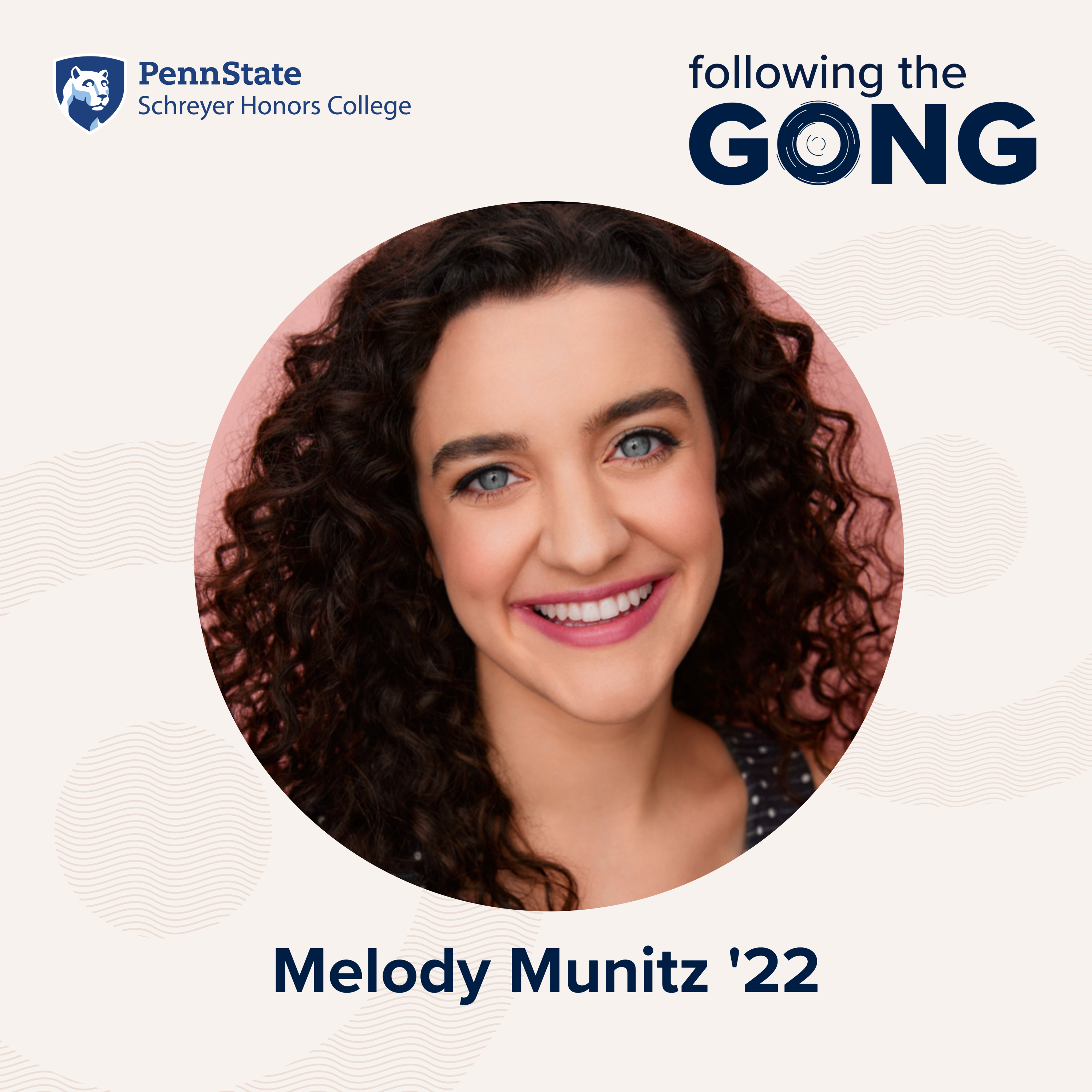
[00:00:12] Speaker B: Welcome to following the Gone, a podcast for Schreier Scholars, bringing you mentoring on demand from scholar alumni. I'm your host, Sean Goheen. And today here in our studio, powered by the Peter Weiler Family Endowment, we have musical theater alumni. She's a theater artist and social scientist, Melanie Muniz, who's joining us at University Park. So welcome to the studio.
[00:00:34] Speaker A: Thanks for having me.
Thank you. It's so good to be here.
[00:00:38] Speaker B: So I'm gonna start, like way back to help set the stage for pun intended for your story. How did you first get into theater? Because I'm sure this was like, way before high school for you.
[00:00:49] Speaker A: Yeah, it was. I saw my first Broadway show when I was six, one month before my seventh birthday, and I saw Mary Poppins. And at intermission, I pointed to the stage and I said, that's what I'm gonna do with my life. And my family said, oh, okay, sure. They were immediately supportive. That was a real theme that began early on. And a few months later, I have an older brother, Jazz, Jazz and Melody. And my brother was in a show, a local play, a new play. And I went and got to watch the dress rehearsal. So I now understand it was, you know, it was the last big rehearsal before the show. At the time I was like, you know, a six year old being like, wee, what's happening?
Look at them. But it was a really small play. It was like four actors, and I was sitting up in the very back of the theater and I was like, this is amazing. I'm dying to be up there. And so I met the director after, and I went up and introduced myself and I said, hi, I'm Melody and I would like to be in your show now.
And he was so sweet. I was like, that's not really how it works. But. But thank you.
[00:01:49] Speaker B: Maybe the next one.
[00:01:50] Speaker A: Yes. He said, I am directing a production of A Christmas Carol in a couple of months.
If you'd like, you can come and audition. You and your brother can come along, you can sing a song. And so I went that day and auditioned with my brother and we ended up getting cast in the show together.
I was the young Cratchit girl and he was Tiny Tim. And we did this little production of A Christmas Carol in like a local out of commission church. And there it was. Then I started performing locally, you know, kind of pretty immediately after, my mom found an advertisement in the Penny Saver magazine looking for kids who wanted to perform in a musical for Cats, which is for musical theater people. Crazy musical. Crazy place to start and then kind of kept performing there and then kind of made the jump to off Broadway and kind of more regional theaters in the area in New York where I'm from. And that kind of continued until, up until high school I was performing at, you know, Carnegie hall and Lincoln center and doing off Broadway show.
I was incredibly, incredibly fortunate to be so close to New York and to have so much familial support and access to resources. And I don't take any of that for granted.
[00:02:58] Speaker B: Well, that's awesome. I think you had the resources, but you also had the determination to like, hey, how many six year olds say, oh, I'm gonna do this? And you actually like are literally doing it. You're here on campus today. You're performing as one of the lead roles in the Addams Family musical as Wednesday.
So that's why you're here on campus joining us. So, you know, you're living the dream, right?
[00:03:22] Speaker A: I really am living the dream. And it's very surreal. Just before I came to Penn State, I was at my hometown in New York. We were performing at a theater like 12 miles from my house. And I had about 100 people there from my childhood. That first director of Cats, my high school theater director, my kindergarten teacher who I was in school with, when I decided this is what I wanted to do when I was on stage for the first time and we did like acting out a book and costumes that we made and all of these people from you, these, these formative years of my life were all there watching my dream come true.
[00:03:55] Speaker B: Well, that's amazing.
So before we get into picking Penn State and getting to really complete the full circle there, what was life for you like as a child actor doing all these shows? I looked at your, your resume and it's just like, it's like a tenured professor's CV of like, when they have publications, you have stage performances.
[00:04:19] Speaker A: Thank you. It's again, it goes back to support and resources. I was so lucky to have an incredible family. And my mom would pick me up from school and drive me the hour and a half to New York City. She would, you know, pack me food in the car and I'm sitting in the car doing my homework, you know, driving to New York City. I get to New York for my call time for my rehearsal or my show and do a show and then get back in the car and my mom will drive me home.
I would get home at like, you know, 11 o'. Clock, then I'd start my homework and probably be up until around 2, go to sleep and wake up at like 5 or 6 to go to school for the next day. And so it went for most of high school. So it was definitely a rigorous experience.
[00:05:06] Speaker B: But good prep for college in the 10th street program. Right.
[00:05:10] Speaker A: Honestly, people had always said college is going to be the most intense time of your life academically. And it's all about time management. And I mean, it didn't end up feeling this way. But my freshman year, you were driving
[00:05:23] Speaker B: an hour and a half.
[00:05:24] Speaker A: That's true. I mean, the commuting component of it alone. I lived four minutes from the theater building, so that really helped. And then once it was Covid, because I was here for Covid college for a lot of it. Then there was no commuting. It was just log into this zoom meeting, which made it easier, but it did sort of feel like it shifted things in a way that there was less of that commuting, timeless of that in between time and everything was kind of knit together. I was following my passions all the time.
[00:05:47] Speaker B: Musical theater, you don't necessarily have to get a degree, but it certainly helps. And it certainly helps coming to one of the top programs like Penn State and the Schreyer Honors College on top of that. So how did you decide that you did want to pursue a bfa and then also that it was going to be Penn State and Schreier?
[00:06:05] Speaker A: I went for my first college visit when I was in seventh grade. I was really excited about college because I knew so early on that this is what I wanted to do. I was like, okay, here we go. Pedal to the.
I went and visited Carnegie Mellon. Sorry, other Pennsylvania institution.
And it was lovely. Had a great experience, but it wasn't the place for me. I just kind of felt it in my gut. Even in middle school, I was like, I don't know. Then I set my sights on University of Michigan because it's one of the other top programs and it has really strong academics, and that was really important to me. And I did a pre college program that was between my junior and senior year of high school. And it was like a college application process to apply for that program and college audition process, too. It was a very rigorous and stressful experience waiting to find out if I'd get my decision letter and it would turn out well. But it did. And so I went and studied there for a month. And it was fantastic learning with those professors. I loved it, but I was so certain that University of Michigan was the place I had to go. I was like, umich or Bus like, this is. This is everything to me. And from the moment I arrived on campus, I was expecting to feel that feeling.
I didn't. And I spent that whole nearly month there with this tiny voice in the back of my head being like, you're having the best time ever. You were learning so much. These mentors are incredible. Like, what a phenomenal experience. But like, I don't know. I don't know if this is your forever institution. And I couldn't place it. It wasn't any particular thing. I didn't feel it.
I finished the month there and my mom and my brother drove to pick me up. And it was actually a really sad day. We'd had a big loss in my family. My grandma had passed away from cancer, and it was. There were just. It was a big slew of kind of challenging things in life that coincided on these particular days. And so my mom and my brother came to pick me up. And we're usually a pretty bubbly family, but we were kind of giving Adams family. We were like, pretty grim.
It was just like silent in the car. And we were like, you know, we're gonna do some college visits on the drive home. It's a 10 hour drive from Michigan back to New York. So we're like, you know, we're driving through Pennsylvania. I know Penn State has a good program.
Why don't we just stop in and see? So we're driving silently in the car and we start driving down Park Ave. And we all just start inconspicuously smiling. We like, see each other in the rear view mirror. And we're like, what's that about? We're not supposed to be smiling today. And we park over at Beaver Stadium and we walk to the theater building. And from the moment I got on campus, I felt that feeling. I had been waiting to feel since I was 13, when I. When I went to Carnegie Mellon. And I just. I knew. I said, this is home and had the best time talking to Shannon, touring around. And then they were like, yeah, we take five girls per musical theater class. And I was like, because I'm falling in love with you. And then I went through the college audition and application process, which. So it's the whole normal college application process plus auditions. So I applied to 10 schools, but it's all these pre screens. So you put yourself on video, which now feels pretty normal. But back then, pre Covid was still pretty strange. And you submit these videos of you singing and acting and dancing and doing all of these arts skills, you send that off to the College. If they like you, they invite you for an audition. Then you have these auditions throughout the whole school year. And so you're trying to finish your senior year, but you're also, like, leaving every weekend to fly to universities.
But I did the whole college audition process, and Penn State was the best of my college auditions. And they asked me about my. I have a background in scientific research, and they asked about it in the room. And nobody in a musical theater audition had ever cared to ask me about neuroscience science research.
And I was like, goodness, these people want to see me for the fullness of who I am. That is something to not take lightly.
It was phenomenal. And then I got in a few weeks later, and I was like, I mean, it has to be yes.
But then I was like, if I get into Schreier, that's really. That's gonna really seal the deal.
Two weeks later, on a Tuesday, I got into Schreyer. And I was like, Ah, 3pm you're logging in.
[00:09:58] Speaker B: You're like, yes.
[00:10:00] Speaker A: Yeah. In the lobby of my high school, I remember so vividly, I left rehearsal to log into the portal and see if I got into Shrier. And I was like.
And then it just got better from there. It was four dreamy years.
[00:10:11] Speaker B: So you mentioned casually here, in addition to some of the places you performed, you were also doing research in high school. So how did you get into that on top of your theater work?
[00:10:23] Speaker A: Honestly, I also got into science because of my brother Jazz.
In elementary school, he's three years above me, and he would always come home from school, and we would have school after school, and he would teach me what he was learning, and he was really interested in science, and I was really interested in science.
And we have an international science research program that has a chapter at our local high school in New York. It's just a local public school, but it's an amazing program, and it's one of the best assets in our district. And my brother started doing cancer research when he was 15.
Developed a cancer therapy. Very casual. He's awesome. He's in medical school now, not doing theater anymore.
But I had always been really into science.
A few months after seeing my first Broadway show when I was 8, we had to do a research project in elementary school to learn how to use computers. And we could research anything. It was in our library class. And I said I wanted to research the brain, and I wanted to understand.
I had, at some point gotten the vague understanding that there were different parts of the brain, and I wanted to know the different functions of those different parts. And that passion stayed with me forever. And so then when I was 15 in high school, I joined the science research program and we could research anything we wanted. And I had read this general newspaper article that was like, can't count sheep. You might have a blind mind's eye. And I was like, what does that mean?
And so I read this article that had just come out by. It was cataloging research from Professor Dr. Adam Zeman at the University of Exeter in England, talking about this newly coined condition, Aphantasia, of people who can't visualize. And I was like, this is fascinating because I'm a very visual learner. That's. That's how I learn all my shows. I read a script page a couple of times and it's in the noggin. That's how it works for me. And so to find out that there's a proposed 2 to 3% of the population who doesn't have that visual imagery capability was incredible to me and fascinating.
And I wanted to learn more about how their brains work and how they work in their fields.
And so I emailed this professor and I said, hi, I'm 15, I'm in New York.
I know you're in England, and this research is just beginning. Is there any chance you want to counterpart stateside? And incredibly, he said, yes.
And so I started conducting research and kind of the liaison in the United States doing the first epidemiological study of Aphantasia, so trying to understand more about the conditions, its biological underpinnings, and the impacts it has on people who have this condition. And found a lot of great information that I was able to share with this audience at the time because people were kind of reading these articles and most people didn't understand that they were any different. They were like other people can see in their brains.
And so it was kind of a growing population of people who were pretty confused and a little like, what? What's going on? And so I was able to kind of share that research with them after three years of doing research in high school and, and say, you are not alone, and here's some information and thanks for participating in this research and as the greater community and. And hopefully this gives you a bit of solace and a bit more understanding to move forward.
[00:13:25] Speaker B: So are those the kind of questions that led you to double major? I read on your website that you were the first musical theater student to add a second major.
[00:13:37] Speaker A: Yes, in a way. Actually, I'm gonna steal that metaphor in a way. It Kind of was bloop tape. It was like blue painter's tape. The tape was like, you can't. Then I was like, but it's pretty easy to, you know, remove that tape. It's adhered, but it comes off with a clean line.
That same time that I had come to campus for the first time and so spoke with Shannon Ritter. I had asked if I could double major. I had expressed this interest and she was lovely, but she was like, no, it's not possible. No one's ever done it. It would take too many credits. And it's too hard to schedule courses because there were ended up being 11 people in my graduating musical theater class. It's a very small cohort, so it's not like, oh, I'll take that math section on Wednesday mornings instead of Thursday mornings. It's like, there is, yeah, there is one class for all of us, and it is at that time. So it's just logistically really, really complicated. And so they were like, no, there are a couple people who have done minors in the past and we can connect you with them, but don't come to Penn State if you want a double major. When I came to campus for my first orientation for Schreyer in May of 2018 and we like scheduled our classes, I was really excited about the honors option because it's not like there were honors musical theater coursework. And so the first kind of gen ed I signed up for was a cognitive psychology class that I was going to, honors option. And then I got an E email over the summer being like, hi, you can't do this. You're a first semester freshman.
You can maybe do this later, but don't start that way. And so I was like, darn it. So I didn't get to take a psych class my first semester, but it was all for the best. Took a great philosophy course. It's very interesting.
But that kind of, you know, that kept continuing to be the narrative of me being like, could I posit this?
And so I just kept taking psychology coursework. All my gen EDS were completed from high school, and so I was able to really fill outside of my musical theater coursework with science classes I was really desperate to take.
And I had an incredible advisor, Margaret Higgins. I owe this double major to her and many other people, but her for saying, let's see what we can do.
And so I declared the minor and just was working towards the minor. And then I just kept kind of saying, okay, so what would happen if I just took more credits than the Minor. And what would happen if accidentally, all of those credits were the credits I needed for the double major.
And she goes, we can try. And So a couple 26 credit semesters later, and I'm sorry, 26. Yeah, which I know now, I read an article a few years ago after I graduated that now you can't take more than like 22 or something. They changed it.
Yeah. So I'm really grateful. I snuck in there when it was possible and, like, got permission for credit overages and that kind of thing. And courses during the summer and then Covid hit during my sophomore year. So in a way, that kind of opened up the schedule and made this double major possible, honestly, because, I mean, sheer commute time, I wouldn't have been able to make it from one class to the next. But by logging it on my computer for half of those classes, it was possible.
[00:16:35] Speaker B: Let's focus on the musical theater program for a minute. What is life like, just as a regular musical theater student here at Penn State? You know, from auditions to classes to actual rehearsals and wrap parties and, you know, the whole process, because it's kind of a unique life. So pull the curtain back.
[00:16:57] Speaker A: Yeah, sure thing.
It is a pretty rigorous lifestyle. It's kind of coursework and course activities from like 9 to 10 every day. 9am to 10pm yes, thank you for specifying. Yes, that is what I mean.
Academic classes throughout the day. Academic and arts. I mean, those are academic too. But like, you know, your 9am class might be a ballet class or a scene study class or a song analysis class.
So classes from like nine to four, kind of pretty much the full day.
And then we usually would have like a little like four to six break. That was usually meetings or like clubs, activities, trying to get some dinner before the dining hall closes, and then rehearsal 6 to 10 for whatever production you're in or working on at the time. And then you head back home and you do your homework. And it's a little bit like high school in that way, you know, burning the candle at both ends. Waking up early the next morning and stretching and going, oh, my neck cracked. Yeah, there you go. I didn't have a 9:00am ballet this morning, clearly. But, you know, getting up and getting ready and doing it the next day.
[00:17:59] Speaker B: So what about being a Schreyer Scholar on top of these other demands? How did you manage the time management? Because you also mentioned clubs too. So what were the time management skills that you were utilizing?
[00:18:11] Speaker A: I think that sometimes I'm thinking about other Schreyer scholars that I got to know and, you know, became friends with through other extracurriculars and classes and that sort of thing. And I think sometimes because there are such specific demands of you have to get this many credits and that sort of thing, it can feel like, well, I just have to take this class to satisfy these credits. But I think that's a slippery slope because I think it's gotta derive from passion and it's not always possible. Like sometimes you maybe have to take a math class you're not interested in, or, you know, substitute math for whatever it is that maybe isn't your favorite. I like math, but I think that's when it starts to feel really taxing if you're able to flip, follow and pursue your passion, even if it's something outside your major. You know, maybe you're a kinesiology major, but you're really interested in this business course and you can take it as an honors option or there's an honors section. I would recommend taking that class that you're interested in instead of that one that fits in your schedule because it's 11 o' clock start time or 11:15 instead of a 9:05. And so you're like, well, I don't want to take the 9:05 class. That sounds more interesting because I want to sleep. I mean, sleep's important too. But I think the more interested you are in the material you're following, the less it feels like work. Because it's such an honor to be here as a student and get a higher education.
Doesn't mean it's not challenging, but yeah, it's a tremendous gift and it does go quickly. And once you leave, you look back on the classes you took. And I draw on that information all the time, whether for my career or just for fun. I'm like, ah, I love when I learned that one fact. And so that information sticks with you and you're paying good money for it. I mean, I paid out of state tuition for a state school, so paying really good money for it, but we might as well get to learn things we're excited about.
[00:19:46] Speaker B: So what were the clubs and involvement?
[00:19:49] Speaker A: One of the most formative major involvements was I was the director and one of the co founders of this arts and health initiative that was directly combining science and art, which had always been my jam. Anoushka Shah was an awesome colleague and peer who was a few years above me in college, and she'd sent out this message in March of 2020. But before March 2020 became March 2020, the beginning the single digit days. Yeah, single digit days, exactly. And was just kind of, you know, garnering interest in, you know, are other people interested in science and maybe art? You know, she was working in science and also poetry and ended up getting her graduate degree in poetry. And I had seen this message come through in one of the group chats. It might have been a Shrier group chat. I don't remember the exact one. And I was like, yes, me. So I went to this first meeting. There was creamery chocolate milk. So of course everyone was happy.
And. And we had our first meeting. And then Covid hit, and so we had to pivot very quickly to understand, you know, this new student initiative and program we're trying to get off the ground. How do we do this? We had Dr. Rick Ordway, who was our faculty advisor. And together during COVID we built this program that ended up being all online as a way to shout out what local artists in Pennsylvania were doing to support wellness. We ended up presenting research for the National Organization for Arts and Health, noaa, and partnering with the Penn State Health System at the medical center and getting our certifications as certified artists in health.
And then I took over the program for the last two and a half years of my college time here and managed a group of other peers, a lot of whom were Schreyer scholars. The rest of my extracurricular time was being on the board of the center for the Performing Arts. They started a student advisory council when I was a student here, and I was on kind of that founding board. And now I'm on the adult leadership council for the center, and I'll be on that stage tonight. So I'm kind of going back home in that way.
[00:21:53] Speaker B: Absolutely. On the flip of that, though, in terms of being a little serious, what was it like being the voice of Penn State?
[00:22:00] Speaker A: I mean, I guess serious, but honestly, just so much fun.
That also was kind of a Covid adventure because they had put out this call, an audition, to sing the alma mater for a national Penn State commercial. And I had seen that email come through, and I was like, I'll submit. And so you just had to submit, like, a little clip of you singing it. And so it was during COVID So I was home on break. I actually was quite sick. Not with COVID I just had a bad cold. And so I went up to my attic where they were like, okay acoustics, but it was freezing up there. I was in my pajamas, and I made a little voice memo of me singing the alma mater, and I sent it off and quite a few months later, because, you know, Covid really disrupted things. I got an email saying that they would like to use me for the commercial. And the original plan had been to bring whatever artist they chose into a recording studio, record it professionally.
But they really liked my audition tape. They're like, can we just use this? I was like, it's from my iPhone. I was sick wearing pajamas in an attic in Covid era. But sure, if you want to. And they did. And so what aired on national TV and online and got over a million views was just a clip of me singing in my attic in the room that I grew up singing in.
[00:23:10] Speaker B: That's incredible. And if there's anybody from Apple watching and wants to use this as a story for made on iPhone, get in touch with Melody here.
You know, I guess that puts you in common with like some of the. Was it Sabrina Carpenter?
[00:23:24] Speaker A: Those ones like, wow, thank you.
[00:23:26] Speaker B: That you see, whoever. Olivia Rodrigo, I think in the commercials.
[00:23:30] Speaker A: Yes. Yeah, actually, I just, I think it was before we were on air. I can't remember, but we were talking about there's a new Sony headphone line and I was doing this campaign for it. And then I found out the other counterpart to the campaign was Olivia Rodrigo, which was crazy good company. Hats off to you, Olivia.
[00:23:50] Speaker B: Well, that actually sets up my next question really well, Melody.
How is that like doing that pre recorded stuff like the commercials or. I don't know if you've really ventured into film or TV yet. I say get. But how does that compare to the live theater? You know, obviously your expertise is on the stage, but is there any, like, highlights from that? What is, what is the difference there?
[00:24:14] Speaker A: Yeah, it's very different in a way there from my vantage point are more differences and similarities, but I guess that really isn't true because, you know, if you're acting, you're acting, you know, you're using your faculties to play a character and portray a narrative that's different from life. So I guess at the base level it's that way. But being on film sets and TV sets for, you know, shows on Netflix and Hulu and Apple tv, you get the sense that it is a massive production. That's one big difference. Whereas, you know, even working on a Broadway show, I mean, there are a lot of people, but it like compares to like one department of, you know, something on screen.
And so that's one difference.
But also it's very, very peace wise. I mean, every night that I step on stage to tell the story of the Addams Family.
This will. Now, tonight will be our, like, maybe around our 55th performance out of, like, 185. So we got a ways to go. But every night it's the same show. I mean, it's. It's different because you make new choices and it's, you know, it's alive. And that's the exciting part about. About theater is it's fresh, and we're reacting to the audience, reacting to us and all that.
Excuse me, but on screen, you are filming in pieces, and, you know, you might film the last scene, and then three months later, film the first scene. And.
And so it doesn't have that same cohesive narrative for us on the back end, which is just a different way to work.
[00:25:35] Speaker B: I want to pivot. We haven't talked about your honors thesis yet.
[00:25:37] Speaker A: Yeah.
[00:25:38] Speaker B: So here's your chance to totally nerd out and tell us about your thesis.
[00:25:43] Speaker A: Sure. So I ended up doing an interdisciplinary honors thesis connecting my musical theater work and my psychology work.
And so I wrote a play called Lonely Together, and I produced and directed it my senior year. And then I ran this concurrent behavioral study. I was a researcher at the Empathy and Moral Psychology lab with my advisor, Dr. Darrell Cameron, and I ran a study on all of the audience members who came to see the show. And what I was really interested in gleaning was the relationship between empathy, how empathetic one person tends to be in their daily life, and where you're seated in a theater, your literal seat distance and seat location as related to the stage and the action that you're watching unfold on stage, the relationship between those two factors and your emotional response to theater. So how, you know, emotionally invested do you get by, you know, artwork based on how close are you to it and how much do you tend to really, you know, cognitively and effectively empathetically react to the world around you? Because kind of colloquially, it's well understood, you know, theater is an empathy machine. That's something that you kind of. That we kind of hear. But there is not practically any qualitative research or quantitative research, especially about how empathy really has a foothold and is crucial in why we are able to have the experiences we can have when we interact with art. And so I wanted to get some numbers on that and ended up writing a thesis and this play. And it was really such an honor to be able to, on that day scale, say, the arts and the sciences belong together.
And that was really what I was the most thrilled about. And now I'm working on getting that research Published.
[00:27:30] Speaker B: Nice. From the business angle, how did you adapt to job searching? And I'm going to use that in the most loose term here for you as a newly minted college grad, knowing that you've been doing auditions since you were the precocious six year old doing the Christmas Carol.
[00:27:47] Speaker A: It was challenging because I graduated in 2022, and so Covid was still a thing, and especially in theater and, you know, gathering in large auditoriums still posed quite a bit of danger. And so our industry of, you know, Broadway in New York City and the theater industry at large was still really trying to figure out, how do we come back from this? It was a major blow to the arc. It was a challenging time to kind of dive in.
And I also had had some health problems when I was a student here, and I had to get surgery right after I graduated. And everything's great. It's phenomenal. And I'm healthy and well now, and I'm so grateful for that experience.
But it was really challenging because I was hoping, you know, I would graduate college and I'd soar. It feels like jumping off a cliff. But instead, I felt like I'm gonna, you know, at my lowest moments, I was like, I'm gonna graduate college. And instead of soaring, I'm like, okay, time to clip my wings, and I'll, like, plummet to the bottom of the valley and, like, you know, move home with my parents and recuperate from surgery. That's not what I want to be doing. I didn't have a choice, and it ended up being fantastic. But then I started auditioning again for theater in August, and it was very sweet. It was daunting.
It's very different than growing up. And also, the industry had changed, and also because of COVID and now I'm a graduate. There were tons of things about it that made it different. And so it was like, okay, here we go.
And I was like, okay, my goal is for the first calendar year, I just want to get a call back.
And the universe was like, come on, you went to Penn State. Have a little more respect for yourself. And I got a callback for that first project.
And then I was like, okay. So then my goal is to get, like, you know, an in person final callback. And I got an in person final callback for that first project. And I was like, okay, that's nice. Thank you. And of course, you know, it continued like a rollercoaster of, you know, exciting projects here and, you know, total flops here of, like, you submit, you audition, you Send your materials and you never hear back. I mean, that's the majority of the time.
It's been a challenge, but then kind of the ball starts rolling and one thing leads to the next. And you work with this director and you form a good relationship or you work on this project and somebody sees you and is like, you'd be great in this. And it's networking in the way that Penn State knows best. Talk about the biggest alumni network. And that's been crucial too.
And so it's sort of been hopping project to project. And I was looking last night. I've been keeping a spreadsheet because I like spreadsheets. Yeah, I guess I'm a Schreyer scholar. People can probably relate to a nice color coded spreadsheet.
But of all the, all the projects I've worked on since college, because at the time, at the beginning it was like, okay, gotta get my first one. And it felt like, is this ever gonna happen? And so I was like, okay, I'm gonna keep a little tally of all my little wins. Like, what's a little, you know, what little show did I get to do here? What big show did I get to do here?
And I've worked on like 78 projects since graduating.
And you know, some of those have been for months. Some of those were, you know, a one night concert. And so it really, really ranges. But it's, it's a lot of balls to keep in the air in terms of.
It's not like, oh, you graduate, you get a job and now you have stability. There's no stability ever.
And so that's a challenge. But it's also really exciting because you never really know what's around the bend.
[00:30:54] Speaker B: From an emotional perspective, how do you handle that some of these digs are one night or that some of these parts might be a week or a couple months.
[00:31:03] Speaker A: It's so interesting. And every project is so different. Every team that you work with is so different.
It's like getting to pop into a different office several times a year, more usually several times a week. And so you get to discover a lot of different leadership styles, a lot of different communities. And that's really a gift.
[00:31:21] Speaker B: You mentioned networking. And so you have kind of this theater community, but you've also been able to tap into the Penn State network.
Do you have an example of that?
[00:31:30] Speaker A: One of the most kind of surprising things that happened after graduation. One of my first jobs is Mike Carnes. He was a student here in stage management in the school of Theatre.
Phenomenal alumni and has Had a lot of alumni features.
He's amazing. And I had met him when I was a student here. We had, like, a big alumni program called Stages, where alumni come back for the School of Theater and talk with us. And he'd been on some panels, and I'd met him over the four years, and we'd stayed in touch. And after I'd graduated and kind of recovered from surgery and was ready to kind of be boots on the ground and dig into some projects, I missed being involved in things I was really passionate about.
And so we'd been messaging back and forth, and he was launching a brand apparel company for universities, and he was looking to get it off the ground. And he knew I was a Penn Stater, and he's a Penn Stater, and he's like, do you want to come on board? And so I started working with him. And he also is the CEO of a company called Marathon Digital, which does marketing and social media marketing for Broadway shows, which I was fascinated in with that Arts for Health initiative. I was mentioning earlier that we had to pivot to online. A lot of that ended up being on Instagram and online, and I ended up becoming a graphic designer, which isn't the thing I knew anything about, but it was kind of a hat I started to wear and then discovered I loved. And so when I was an undergrad here, I started doing a lot of graphic design and web design, and it became a really marketable skill and is now kind of a whole facet of my career, kind of a kind of side experience.
And so I got to kind of come alongside him, and he ended up bringing me on to the company at Marathon Digital, and I got to work on marketing for, like, 15 Broadway shows. I'm having actually another Penn State experience about that. Now there's a theater company, an Off Broadway theater company in New York City called J2 Spotlight. It was started by Jim Jamiro, a Penn State alum, and Rob Schneider, a Penn State alum.
And I met them through the Penn State network. And I've got to kind of come on board with that company over the last three years and have performed with them, was an associate director with them, and kind of worn a bunch of different hats with this company. And now I'm working as their press agent. I was supposed to be their line producer this season, but then when I booked this tour and knew I'd be on the road, I was like, I can't really be boots on the ground in New York City.
And so I just this morning sent off our Next batch of press releases and said to Rob, you know, I've done a lot of marketing and writing, but I haven't explicitly been a press agent.
But I love you. I love this company. And. Sure.
And so I've learned a lot about that now and again. Just Penn Staters being incredible and. And keeping it in the family.
[00:33:58] Speaker B: What was surprising to you when you went on your first tour and doing kind of like you're traveling, you're going there, versus all of your previous experiences? I don't know if you call it stationary or residential. I don't know what the term is,
[00:34:10] Speaker A: but usually like, regional. Because they're in different regions.
[00:34:13] Speaker B: Yeah. Or even here at Penn State where they're like, okay, all of our performances are at Schwab Auditorium. Or all of our performances are at the Rodgers and Hammerstein Theater on Broadway.
[00:34:22] Speaker A: Yeah.
[00:34:22] Speaker B: Like, what are the differences there?
[00:34:25] Speaker A: Well, one of the biggest kind of just base logistic differences is you're on a different stage, the venue is totally different. Your dressing room's in a different spot, the stage is a different size, the material of the flooring is different. And if you're dancing, that makes a big difference.
The number of seats is wildly different. The arrangements of seats, whether the theater was built 100 years ago, like the theater I was just at in Boston last week, or whether the theater is two years old, like a gorgeous theater we were at in North Carolina last month.
And so, you know, whether it's ornate with gold leaf, you know, peeling on the ceiling, and it's mag, or it's got that newest high tech equipment and it feels really modern. That makes a difference in the audience experience and thus makes a difference for us on stage, feeling how the audience is reacting.
I just was performing in my hometown, and it's at the West Point Military Academy. They have this huge theater there, and the audience was so far away from us. And so with a show like the Addams Family, it's really a comedy. And people are laughing, like, bursting at the seams with laughter every, like, three minutes. And we're used to really having long pauses and waiting and hearing that, like, uproarious laughter. But this theater is so cavernous, and the audience was so far away from us that we were kind of holding for laughs in the normal places. And we could hear that they were happening, but it sounded like they were happening on the other side of Beaver Stadium because they almost were.
And so that. That makes a big difference. So the logistics of that are unique. And then, you know, the lifestyle shift are tremendous. You know, I'm not at home or in an apartment. You know, the same commute every day. It's. I'm in a hotel in a state I've never been to, and, you know, everything is kind of completely uprooted. And again, back to the point of kind of keeping us on our toes, and life is always shifting. And so working on a touring production every day kind of looks brand new.
[00:36:09] Speaker B: What is your favorite role to date that you've played, and what is the dream role that if there's one character you can play before you were to retire from the stage?
[00:36:19] Speaker A: Oh, retire from the stage.
[00:36:21] Speaker B: After a long, successful career full of Tonys and Oscars, what is the one role that you would want to play?
[00:36:30] Speaker A: Oh, gee, okay. That part's hard. I'll start with my favorite, which is also hard too. I'm gonna cheat and give you a couple answers. When I was here at Penn State my senior year, actually, we closed my birthday April 23rd, just a week before graduation, I got to play Fiona in Brigadoon, which was a dream. It was a gorgeous show. To get to stand center stage in this handmade gown on this gorgeous set, you know, working with incredible collaborators, kind of culminating my Penn State experience.
That was a dream come true.
I've played a lot of roles I've really, really loved since, but a big highlight was Elizabeth Bennett in Pride and Prejudice. There's a new musical adaptation by Tony nominated Broadway composer Paul Gordon, who is now a close friend of mine. I adore him and I. It was only the second world production of this, and it was the regional premiere, so it had been done a little bit. But again, there was a lot of space to kind of create.
[00:37:20] Speaker B: She's the main lead, right?
[00:37:21] Speaker A: She is. And actually, in this show, it's a wild interpretation where she is on stage the entire show. I sang 17 songs. I was offstage for a minute and 30 seconds, broken up over six different exits for quick changes. And so I was on stage, and it was the most challenging role I've played because it was so demanding.
But I just. I love that character. She is so sharp and strong, and yet we watch her fail and have to adapt and make space in herself. And isn't that just a beautiful story to meet a strong woman who also discovers she doesn't know all the answers? Like, yeah.
So I really, really loved that show, and I dream about playing that character again. A couple that I would love to play, Anya and Anastasia, which I actually get to play in a couple months. We get a break from The.
And I'm going to go back to that theater where I played Elizabeth Bennet and get to be Anya, which is going to be wonderful.
And Eliza in My Fair Lady.
[00:38:19] Speaker B: Oh, great one.
[00:38:20] Speaker A: Chris Anna in Frozen Matilda. I love the show Matilda. I can't play Matilda anymore, unfortunately. I'm not that precocious six year old anymore. But Miss Honey in Matilda the Teacher,
[00:38:30] Speaker B: I can see that.
[00:38:31] Speaker A: Love that role. Thank you very much. But those are some of my big dreams in terms of kind of down the line, Stephen Sondheim, basically, his whole canon is just ripe with gorgeous material. I mean, again, so many strong women and so many people who are really figuring out complicated things in their lives.
[00:38:49] Speaker B: So in addition to acting, singing, and presumably dancing in a lot of these, you have mentioned kind of in passing here in our conversation, you're really involved in some of the production side. You've done some writing, some acting, or obviously, duh acting, some directing is what I meant to say. You know, how do you leverage your stage experience and bring that to influence those other roles? If that makes sense.
[00:39:18] Speaker A: Yeah, it makes a lot of sense. I've been so grateful to wear so many different hats in the arts because it's like, it's like, you know, bring your child to work day, you know, you know, the little girl gets to go in. And I remember going to the office with my dad when I was 10 and, and sitting an extra chair at his desk and seeing, oh, this is how it works. Oh, and so sometimes I still feel that way when I step into a new role or a new project and I'm doing a slightly different series of tasks. I'm like, oh, I'm kicking my feet that can't quite reach the floor and I'm like, gee, okay, all right. So a press agent does this, and for a lighting designer, these are the three really important things to know. And, you know, when I'm working as a director, I better know what everybody does. And so, so to try to continue to glean more information and figure out what really builds this community, because especially arts, but any industry, we can do so much more together than we can do apart. Apart. What can we accomplish by ourselves? And so it really takes us all collaborating and working together. It's one of my favorite things about the arts. And so when I get to try my hand at all these different capacities and all these different tasks and roles, I get to really learn it from their perspective and take a walk in their shoes.
And so then when I come onto a project in any other capacity, I'M really grateful to know a bit of what it's like to have been that role.
And so hopefully it allows me to be a more compassionate and empathetic collaborator, regardless of the role that I'm fulfilling at that time.
[00:40:42] Speaker B: What's your favorite thing to do around the theater? That is not acting.
[00:40:46] Speaker A: Directing.
[00:40:47] Speaker B: Directing.
[00:40:47] Speaker A: Directing, for sure.
[00:40:48] Speaker B: If you could direct a show, what would you direct?
[00:40:51] Speaker A: Oh.
Oh, I should have an immediate answer to this, but I don't. A lot of the things I've worked on have been new works, so maybe
[00:41:00] Speaker B: it hasn't been written yet.
[00:41:01] Speaker A: Yeah, maybe. Maybe it hasn't been written yet.
[00:41:04] Speaker B: So on the business side, how do you handle, like, things like taxes and finances? I don't need to know what you get paid, but like, you know, you're dealing with paychecks and different states. You know, some states have heavy taxes, some don't tax you at all. Some cities do, like Philadelphia, probably New York. You know, you're performing different companies in the same year. How do you keep track of all that? Because it's one thing to be like a new grad. You go to one company and you're doing a W2. Maybe you have a side hustle. It's pretty straightforward. Yeah, you have all that plus your side hustle of the graphic design, social media landscape. So how do you keep track of the necessary, boring side of things?
[00:41:44] Speaker A: It's complicated and it's something I'm still figuring out because, you know, all of my two now, you know, part of a third year since graduating have looked different. You know, my outline of, you know, where is my income coming from and how many companies am I working with and are these long term projects or short term projects? That's continuing to evolve and it always looks different. I was actually talking to a cast member, the woman who plays my mom, Morticia in the show. She was doing her taxes last night in the hotel and we were talking about how she can't submit quarterly taxes because she has no idea how much she's going to make in this quarter versus that quarter. And so, you know, come tax season at, we owe a lot. And so it really depends. And I'm still kind of figuring out the best way to do it. And that'll probably look different for every year of my life. That's, yeah, part of the contractor shtick, but comes back to spreadsheets. Maybe this podcast is called Schreier and Spreadsheets, but that was something that I started right after I graduated. But back then I started to get the sense pretty Quickly. That projects had different ranges of time and that I better find a way to keep track of this. So I started a spreadsheet for every project I worked on and if it was a 1099 or a W2 or what kind of contract.
And how often was I getting paid? Who was like, the pay stub company? Were these direct deposits? Was I getting checks in the mail?
Was I paying taxes up front? Was I getting net wages or gross wages? And this I would need to report now and pay quarterly taxes, and this I can report later the next year.
[00:43:09] Speaker B: What municipality was it in exactly?
[00:43:11] Speaker A: Yeah. What state was I in? And that became infinitely more complicated when I started working regionally at different. Different, you know, states around the country, and then again when I started touring and have to pay taxes in every state at performing. But ultimately, yeah, it's. It's just. It's just complicated.
[00:43:26] Speaker B: Yeah, I was gonna say, like, it's probably the thing, like, you don't really think about, like, you're so excited about auditions and the callbacks.
[00:43:32] Speaker A: Yeah. It's like, oh, April comes around. You're like, oh, I worked in. Yeah, I worked in, like, 18 states this year. Wow.
[00:43:40] Speaker B: 18 different tax policies. That's a whole separate podcast on tax policy go down there.
But I do have another business question for you. So for the really serious performers, whether stage or screen or even, like, literary, when do you know that you need to get an agent? I don't know if you have one yet, but, like. Or.
And if you do, how do you get one?
[00:44:02] Speaker A: Like, so I do not have an agent.
[00:44:04] Speaker B: Not yet.
[00:44:05] Speaker A: Not yet. And I'm really happy. It's been great. It's meant that I've had complete control over my career. I get to say yes to all the projects I want and say no to all the projects that I don't jive with.
And I'm keeping my 10% or my 15%.
Agents and managers are incredible. They help you get into rooms and towards opportunities that you wouldn't otherwise be able to access. And there will absolutely come a time. There's some managers I'm in conversations with who I've known for years and have been excited about collaborating. We both have been, but the timing hasn't been right. But. But the time will absolutely come where it's the right moment and also the right fit. It's got to be the right person. It's like inviting somebody into your personal boardroom of your life and your career and making all those decisions together. It's also an interesting time in the Industry where the avenues to booking work as an artist are different than they ever had been before since COVID And regardless of COVID in terms of technological access and just a lot of policies shifting. Actually, Actors Equity, our big union for actors, just made a massive announcement two days ago, actually yesterday, yesterday morning, about audition access and who will and won't be able to be seen and submit for certain projects. And so things are shifting all the time. And it's important to have insight from masters and people whose whole job it is to kind of understand that access and help kind of advocate for that access.
But also it's a constantly shifting landscape. So not having representation in that way, it doesn't preclude you from, from having a vibrant career.
[00:45:30] Speaker B: So, Melody, you spend a lot of time not only on stage, but doing the press and promotion for your shows, especially when you're touring.
What advice do you have for scholars or students generally who have public facing roles or have a social media presence, whether that's like sales, acting or anything else where they're out there doing these kinds of things? What advice do you have for somebody who doesn't have that same level of, of experience, expertise and training that you do?
[00:45:58] Speaker A: Sure.
It's a multifaceted answer because on one hand, we're in such an era of content, and with social media now, it feels like every moment like, gee, okay, today I'm eating breakfast. Well, suddenly that's like a content opportunity. If you want it to be, you're for the right people. And so in that way, it doesn't require going into a big fancy studio for NBC or PBS or npr, who I was chatting with in Boston last week.
It doesn't require that same level of production value to, you know, kind of share a message that can get lots of eyes on it. So that really, you know, blows the doors wide open and also, I think, invites more opportunities for authenticity. Not necessarily saying that everybody needs to vlog about their breakfast. Please don't, please don't.
I don't want to know.
But it does mean, I think, that people can kind of show up as themselves and people seem really interested in authenticity. You know, all of our individual social media feeds are full of, like, really niche things that really speak to us. And so I think it's a great opportunity to think about who is your audience and why are you sharing this message. Ideally, because it's something you're passionate about and something you want to share.
[00:47:03] Speaker B: That was all really good insight there.
[00:47:05] Speaker A: Thank you.
[00:47:06] Speaker B: Again, on the business side of things, if you ever have downtime between shows or tours or anything. How do you fill that void to make sure that you're still earning an income, but also trying to set up the next opportunity or dozen.
[00:47:21] Speaker A: Yeah, it's wild because things overlap in so many ways.
I might be. I mean, like a tour is pretty all encompassing in that it's really uprooted my life. But other projects, like I was working at the University of Chicago, they have this scientist, technologists, artists generating exploration, Lab, Stage Lab. It's an interdisciplinary science and theater lab. And I started working for them when I was an undergrad here, actually, thanks to a Schreier email that I got when I was a freshman.
It was like a job opportunity newsletter, and they were searching for postdocs, and somehow it was just like on the mailing list for everybody.
And I read this email and I found out about this lab, and I was like, I am not a postdoc. I'm in fact, one month into my freshman year of college, I am no things. I am nothing.
I have not gotten a transcript. Yeah.
But I wrote them an email and then kind of kept poking them for four years. And we ended up creating this beautiful collaboration when the time was right and the project was right, and they ended up commissioning me as a playwright and researcher in their lab. But it's. It was. It's all remote work. I've actually never been to the University of Chicago campus, which I'm hoping that will. Not yet. Yeah. On tour when we go to Chicago, I'm really, really hopeful I can finally step foot in our lab.
But a project like that, you know, years long, and so you can kind of plug into that more significantly at some times, versus less. Like, I'm not working on that project at the moment because, you know, this is pretty. You know, this takes my time, but that'll be there, hopefully. And those connections, you know, and the passion about those projects that kind of lives on in an ethereal and tangible way. And so it's kind of dialing into certain things at the right moment.
But my free time these days, I'm working on launching a company called Virtual Stage Lab.
And it's at the nexus of theater and film and trying to increase access to the arts and democratize the process of creating new theater and film and TV and media.
And that's also something that's been able to be remote because I'm the marketing communications director. And so it's a lot of graphic design, a lot of web design, a lot of kind of press and marketing work, and a Lot of zoom meetings and that sort of thing, and so that I can do from the bus on tour. So it's about kind of finding the right thing for the right time.
[00:49:37] Speaker B: So, Melody, you graciously took some time out of your busy schedule while you're here.
You know, you are sharing your advice with scholars, and this whole college was built on giving back. And you've talked about some mentors that you've had. What do volunteerism and philanthropy mean to you?
[00:49:56] Speaker A: It's everything. I mean, we're talking about people in the past who've done remarkable things. I mean, that and then some. Like, that's exactly how we're all here. You know, we're sitting in this gorgeous studio, thanks to an amazing endowment, amazing supporters, and the same with all of the amazing Penn State initiatives I was talking about. We have incredible supporters over there and incredible philanthropists, some of whom will be at the theater tonight. And I'm planning to go meet in the lobby and see after several years and reconnect. And so all that's to say, none of us do this alone. And what can we really build alone? We can all come together and build our passions, and different people have different access to different kinds of resources. And so to be able to kind of pull that together and build something greater than ourselves, that's how society works.
And especially, you know, successful microcosms of society like Penn State or like a theater company.
And so that's everything. And that's really a way that I approach a lot of the work and a lot of the communities I come into. And I've been trying as much as possible to really connect boots on the ground with those communities. For example, on tour, I've been speaking to so many Girl Scout troops from local communities, talking to the high school theater programs or, like, artists in residence at their, you know, at their specific theater or in their regional community, and trying to kind of speak to this next generation or kind of previous generations who are now supporters of the arts and kind of connect those bridges. Because things that are inaccessible to us, we can only access so much. And so somebody, maybe across the room is passionate about the same thing. We are or is seeking someone with the expertise that we have, or vice versa. And so if we're able to. To kind of create those bridges, we can build a lot together.
[00:51:32] Speaker B: So we're gonna wrap up here with kind of our rapid fire questions.
[00:51:35] Speaker A: Ooh, okay.
[00:51:37] Speaker B: What would you say is your biggest success to date?
[00:51:39] Speaker A: I think, on paper, leading a Broadway national tour.
I think in my heart and mind, like, waking up every day and living a life that I love and getting to share stories with people and in a way that hopefully impacts them and educates them, inspires them.
[00:51:54] Speaker B: What's, like, the biggest transformational learning moment or mistake that you've made? I'm sure there's parts that you didn't get. Oh, yeah, Talk about some of those. Like the dark side of the shadowies. I don't know what the right word
[00:52:06] Speaker A: is, but the flip side of that, for sure. Oh, my gosh. I mean, the roles I haven't booked, like, that spreadsheet is much longer than the roles I have booked. But there's also, like, the failure of, like, oh, I applied for that job. I applied for that role, and I failed. I didn't book it. I didn't get that job.
But I tend not to think of those as failures. For anybody in the arts or anybody in any career who's putting themselves out there, that is a win, that's a success.
And whether or not it ends up being the right thing for you, every no is a yes in another direction. But I think it is important to kind of have that perspective of leading with kindness towards yourself and others and understanding that we're only human, we can only do the best we can do, and hopefully we'll learn from it on the other side. Side.
[00:52:49] Speaker B: Awesome. I think that's really helpful to hear because it's like, you have this great resume, you're in this touring, but it's like. Yeah, I'm sure there's been some hiccups, too.
[00:52:58] Speaker A: Oh, my gosh. Yeah. Absolutely.
[00:52:59] Speaker B: We don't need the toxic positivity, right?
[00:53:01] Speaker A: Yes. No, no toxic positivity. Just healthy positivity. Yes.
[00:53:05] Speaker B: Yep.
So you've mentioned a lot of people, and your ability to recall, like, specific dates for. For things is incredible.
So out of all of the.
You've mentioned a lot of faculty, but are there other, like, friends or castmates or clubmates that you also wanted to give a shout out to in addition to all the great influences that you've mentioned so far?
[00:53:26] Speaker A: Oh, my gosh. The list could go on and on. Last night, actually, I was looking back at my acknowledgments page for my thesis because I just. I was feeling sentimental and I was reading, you know, all of these people that with whom I would not be here.
I mean, I'll just ramble off names, but I'll miss probably hundreds of people who had such impact and people whose names I don't know, like, incredible. There was this wonderful man who didn't wear a name tag in the dining hall. But he was there for years, and he was so kind to me. We would have the greatest conversations in the dining hall. And I feel terrible that I don't remember his name now, but it was like, a year into our friendship that I first learned his name. It was one of those.
But so, you know, there's people or people you pass on the street who smile, and they smile back at you, and, you know, and it's like, hey, that really made difference in my day.
I really. I just would need to, like, sit down and be like, oh, and don't forget them from this class. And this and this and this and this and this.
But Dean Carpenter, and so many friends. I mean, so many friends. My classmates, I'm so proud of them. Everybody's out there thriving. I mean, last night, like, Malik Bilbrew, my classmate, you know, got a golden ticket on American Idol. Like, that's amazing. My friend Jeanne Aljour released an EP of gorgeous music that I remember hearing the first demos of when we were students here. Tegan Reynolds, she's working on a new play in New York. And like, so many people, you know, mad Sparks. She was just on an episode of Law and Order. Like, people everywhere. Noah Silverman, a classmate of mine, is on another Broadway national tour with Book of Mormon. Mary Rose Brendel's on the Broadway national tour of Mean Girls.
Everyone is out here living their dreams, and I am so proud and grateful to know them and be able to cheer them on. Oh, my gosh, Jasmine Forsberg, star of Broadway. Three Broadway shows in a year, and, oh, my gosh, JSAV and Julio Ray. And just truly, the list goes on and on because Penn State's an incredible network.
[00:55:18] Speaker B: As we're wrapping up our time, what is a final piece of advice? Think of maybe a second Instagram reel or YouTube short to leave us with.
[00:55:24] Speaker A: Continue to stay open and be excited about what's around the bend, because we never quite know, but it's probably something better than we could have predicted.
[00:55:32] Speaker B: Awesome.
You know, it's so funny because, like, you're so bubbly, and then you're playing Wednesday.
[00:55:39] Speaker A: That's what I mean. I wouldn't have thought this. I mean, the white collar helps, and. And when I put on the wig with the braids, I'm like, okay, there's Wednesday and the dark lipstick and the eyeliner for days. But we're pretty different in our demeanors, that's for sure.
[00:55:53] Speaker B: Well, that's a Good thing, I think.
[00:55:55] Speaker A: I think so too.
[00:55:56] Speaker B: So, Melody, I already mentioned you have this great website so that you can google and find.
[00:56:01] Speaker A: Thank you.
[00:56:01] Speaker B: With all of your listing of shows. But if a scholar wanted to talk to you or a musical theater student to talk to you, what's the best way to connect with you?
[00:56:09] Speaker A: Absolutely. On my website, melodymunits.com, m E L O D Y M U N I T C, there's a contact form. My email is also listed there. It's melodymunizmail.com. yeah, you can contact me on there. My Instagramlodymunits spelled the same way as my name on Facebook. The same way. LinkedIn the same way. Please reach out. I've gotten so many emails in the last few months of people coming to see the show who are playing Wednesday in their school who want to come to college here. I've met up with some people across the country who are dying to come to Penn State and gotten to get coffee with them and chat with them about my experience and, and my recommendation. And I love to talk to the next generation of folks. So please reach on out there doing
[00:56:47] Speaker B: the work, recruiting the next generation of theatrical lines.
[00:56:50] Speaker A: It's an honor.
[00:56:52] Speaker B: And as promised, we're gonna talk creamery.
So if you were a flavor of Berkey Creamery ice cream, which would you be? And Melody, as a scholar alumna, the really important question here is why would you be that flavor?
[00:57:04] Speaker A: My favorite flavor is WPSU Coffee break, and it is what I had last night. And the thing that I love the most about it is it's so creamy and smooth and coffee flavored. But then you get these little bursts of chocolate that are like a surprise. So let's see if I'm. If I'm really getting meta about this. Maybe those little bits of chocolate are the surprises in your life you couldn't have anticipated. And then, oh, what a treat. You know, you have this background of, like, bliss and then you get these fun little bursts of joy.
How does that work? Also alumni swirl. I feel like I better say that as an alum. But the little bits of blueberry, again, such a joy, such a surprise. I think that's probably what I'll have later today.
[00:57:43] Speaker B: Awesome. Well, unlike the creamery, we'll let you mix flavors here.
[00:57:47] Speaker A: Oh, thank you.
[00:57:48] Speaker B: I know sacrilegious on this show.
[00:57:50] Speaker A: Oh, oh, good. Okay. I'm in good company.
[00:57:53] Speaker B: Well, Melody, thank you for joining us.
[00:57:54] Speaker A: Thank you for having me.
[00:57:56] Speaker B: Your, your run of shows here at Eisenhower Auditorium, sharing all of your insights before I let you have the last word. Scholars. If you're watching on YouTube, you know the drill, like, comment, subscribe, all those things if you haven't already.
And if you're engaging with the audio version on whatever podcast app you're using, whatever their verb of choice is, like, follow, subscribe, do that, leave a rating if it lets you. We really appreciate that. And share with a friend who's also a scholar, especially if they're interested in any one of the different episodes that we've had.
And with that melody, I'm gonna let you close this out here.
[00:58:28] Speaker A: Well, I feel like my last words have to be, we are Pennsylvania. Stay.
Well done.