Episode Transcript
[00:00:00] Speaker A: Foreign.
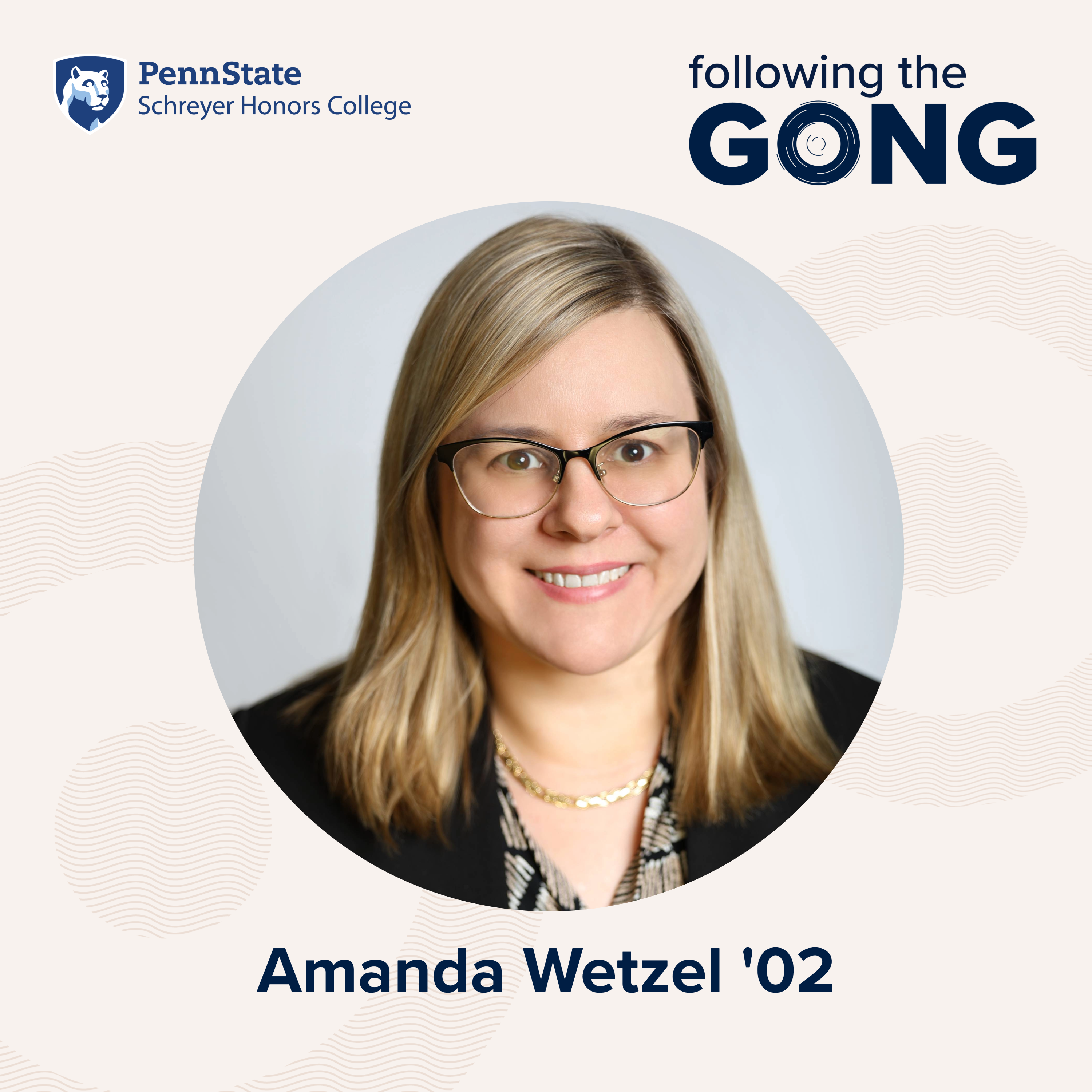
[00:00:07] Speaker B: Welcome back to following the Gone, a podcast for Schreyer Scholars, bringing you mentoring on demand from our Scholar alumni. And we are here today in the studio, powered by the Peter Weiler Family Endowment for Advancement. And I'm joined by globally fluent attorney, class of 2002, Amanda Wetzel. Thank you for joining us here on campus.
[00:00:28] Speaker A: Oh, thank you for having me.
[00:00:29] Speaker B: So I'm going to go a little bit different than I normally do, and I want to dive right into your thesis experience here in the college. You said you wanted to write one, helped you inspire you to join the college, and it seems like it was pretty influential in your story. So can you talk about your experience, how you picked your topic, studying abroad, the whole element of it?
[00:00:50] Speaker A: Yeah. So my thesis was a big part of my experience at Penn State. And I was in College between 1990, in 2002, studying international politics. So one thing that we studied was the Northern Ireland peace process because Senator George Mitchell was instrumental in that. And it was very recent history at that point.
So I started to study the peace negotiations. And what I learned was that there was a political party made up of women, both Catholic and Protestant, that successfully contested the elections to participate in the peace talks and were also the only women at the table and in the peace talks. And so I connected with some professors in the political science department, as well as in the geography department, who specialized in women in politics and or Northern Ireland. And also we had our honors advisor generally for political science, who was also involved in my thesis. And I developed through the thesis classes in political science, a research strategy that was an ethnography. And so I traveled to Northern Ireland this summer after my junior year at Penn State, interviewed many members of the Northern Island Women's coalition based on an interview profile that I had developed through these classes at Penn State. And I was studying the collective identity of the coalition. So there was one prong of my research where I was at the Troubles Library at the Linen Hall Library in Belfast. And I looked at the political communications of the women's coalition and coded them based on the values of the coalition as they set them out in their materials, which were equality, inclusiveness, and human.
And then I also conducted interviews asking women in the women's coalition why they joined and what values they identified with the most and what drove them to become involved in politics if they had never been involved in Northern Ireland politics before.
So it was very interesting project. I was so grateful for the cooperation of the many members of the women's coalition who I spoke to.
And they are A remarkable piece of history in Northern Ireland.
[00:02:57] Speaker B: So what was it like doing your research abroad? You said that they already had a library set up for the Troubles before it was probably even over.
[00:03:06] Speaker A: Yeah. So the Lindenhall Library is an independent library in Belfast, and part of what it hosts is an archive of political communications on the Troubles. And so I was able to go into that archive and take out all their materials that they had saved, which were all of the political communications of the Women's Coalition. And you could have done that for any political party in Northern Ireland. And I was able to review them and make photocopies of them. And so that was part of my research.
And then the second part of the interviews I conducted using a snowballing research method. So I had reached out in advance to the Women's Coalition, I had some contacts. And then as I interviewed each woman, I asked them, well, who should I also talk to? And then they would give me the names and contact information. And I think it's a characteristic of Irish culture to be kind of, like, warm and welcoming and. And people were basically more than happy. The women were more than happy to talk to me and make time to, in some cases, welcome me into their homes for a cup of tea and have a discussion about their involvement. So it was a great experience.
[00:04:08] Speaker B: That is really, really cool.
And so I have to ask, Amanda, because the way you're describing the research process, I imagine that this was good prep for your legal career. Is that something that you found?
[00:04:20] Speaker A: It was. So at the same time that I did this research in Northern Ireland, I was also an intern with the US Consulate General in Belg.
And through that process, one big institution in Northern Ireland is the Queen's University of Belfast, which is where I did one of my Master's degrees.
And so the consulate was in touch with professors at the Queen's University of Belfast. And I was introduced to the Law School at the Queen's University of Belfast, which has many excellent programs, one of which is an LLM in Human Rights Law. So I sort of became aware of the opportunity to study human Rights law at Queen's while I was an intern and do my thesis research as an undergraduate.
[00:05:05] Speaker B: Awesome. So what is an LLM as opposed to a jd?
[00:05:12] Speaker A: So an LLM is a Master's of Laws. And in the United States, you would not be admitted to a Master's of Laws unless you had previously done your first law degree.
That is not the case in the uk, I believe, or in Ireland. I could have also done an LLM in the south of Ireland because there are different paths to qualifying to be a lawyer there. There were other students in the program that had done their undergraduate degrees in international politics or politics or another field. And then they were studying human rights law at the graduate level.
So it is a grad. And LLMs tend to be at some universities, particularly European universities, more specialized. Whereas I went to Columbia for my J.D. there's an LLM program at Columbia, but it's not necessarily specialized in only human rights or only corporate law.
It's a broader degree.
[00:06:02] Speaker B: Gotcha. So you ended up there as part of a really competitive post graduation. We call them fellowships. There's scholarships. So there's the Rhodes Marshalls and you did one. It was the Mitchell Marshall.
[00:06:16] Speaker A: Mitchell.
[00:06:16] Speaker B: Mitchell.
[00:06:17] Speaker A: Mitchell Scholarship.
[00:06:18] Speaker B: Yeah, talk about that.
[00:06:19] Speaker A: Yeah. So the Mitchell Scholarship was a scholarship program named after Senator George Mitchell. It's been ongoing for 25 years. There's a class of Mitchell Scholars who are currently finishing up their experience experience in Ireland. And so it was a competitive application process just like the other scholarships that you just mentioned.
And there was an interview process on campus in the spring of my junior year. And then I believe in early October, the applications were due in my senior year. And having spent the summer before that in Northern Ireland learning about Queens and you know, interviewing women from the Northern Armed Women's Coalition and interning. I was very driven to apply for the Mitchell Scholarship because I really wanted to come to go back to Queens and to continue to study in Northern Ireland.
So that was a selection process that took place in the fall of my senior year at Penn State. And then I started at Queen's in the fall of 2002 as a student.
[00:07:14] Speaker B: So I know you do a lot of mentoring for students or talking with them around these fellowships, these big prestigious scholarships. And it's not surprising whenever these are announced that a good portion of them punching above our weight class are Shrier scholars. Not a requirement, but certainly there's correlation there. Right. So what advice do you give to students who are looking at things, whether it's astronaut scholarship, Rhodes, Mitchell Marshall, all these awesome opportunities to further their studies.
[00:07:45] Speaker A: Well, I think for.
I'm not saying that every student should study abroad, but I think that many students should consider it because studying in the UK or Ireland or on maybe a State Department sponsored program in another country is an eye opening experience. And I not only studied on the Mitchell in Northern Ireland, but when I was at Columbia I did a joint degree program with the Sorbonne Paris and both programs, both at the Queen's University of Belfast and in Paris, I learned new ways or different ways of thinking about the law than the ways that we do typically in a US Law school.
So I would encourage everyone to think about studying abroad and gaining a new perspective. And I think that can. Sometimes that could be like in a master's level, and sometimes that could be more of a service project, but I think that many students should consider that option.
[00:08:41] Speaker B: Awesome. And if you have questions about study abroad, our colleague here, Sarah Lyle Combs, can talk to you about that. We have funding available for study abroad. I'm sure you tapped into that when you were a student here.
[00:08:53] Speaker A: Yeah, that's right.
I received funding both from the Political Science department and the Honors College to carry out my thesis research and my internship in Northern Ireland, so.
[00:09:02] Speaker B: Excellent. And it could just be for courses, for research, for presenting. So come talk to us.
Really great opportunities there.
So when students are applying for these programs, like, what is. What was the actual application like? Do you remember? Like, was there interviews, essays, was there like practice sessions, anything like that?
[00:09:24] Speaker A: Yeah. So the Office of Undergraduate Fellowships at Penn State had some resources to help you complete the applications for these programs. And I think that one very important component of an application to study at the graduate level abroad with funding is a personal statement. And I think that it is maybe the most important aspect of it because it's where you have the opportunity to explain to the selection committee why you're proposing an important project that should be carried out or that would be enhanced by being carried out at a university in Ireland or the UK for some of the major scholarship programs. So I think that it's good to start in the spring of your junior year thinking about it, because your thoughts as you learn more about the programs and as you talk to people who participated in them before you, your thought process of how you'd like to shape your personal statement can evolve. And it's not something that you want to do over a two week period. It's something that you want to do over a several month period.
[00:10:28] Speaker B: So start early.
[00:10:30] Speaker A: Yeah.
[00:10:30] Speaker B: Awesome. And that probably goes for study abroad too. Start planning that out. Right?
[00:10:34] Speaker A: Yeah, especially, I mean, I think for many study abroad programs, you have to make sure that fits in with your course requirements at Penn State.
[00:10:40] Speaker B: So excellent.
So you did your Mitchell Scholarship, you get your first Masters, and obviously this is a Shrier podcast. So casually just dropping my first Master's in conversation. I didn't miss that earlier.
So you had a pretty unique run through your legal career. You mentioned going to Columbia, but you had this dual program with the Sorbonne in Europe. So can you explain your path through law school?
[00:11:09] Speaker A: Sure. Well, when I came back from Northern Ireland, I applied for law school in the United States and I applied to many law schools that had joint degree programs with universities abroad. And I was accepted into Columbia and ended up attending there.
And Columbia has, and many other universities also have a variety of study abroad options in law school, but also joint degree options where you not only study at the university, but you come out with a law degree from a foreign university, which can be a good idea if you want to focus on international law in your career and if you have any idea that you might want to practice abroad.
So at Columbia, I had taken French at Penn State and I had spent some time in France immediately following the time that I was in Ireland. So I was fluent in French, and that's why I was interested in the dual degree program offered in France.
Columbia has a couple of options, one of which is a four year degree program with two years in New York and then two years in Paris. And so I chose that option. And it was, I won't say that French law school was easy. It was a challenging thing to go over and study entirely in French and to study in a system that has a very different evaluation process than what we have in US Law schools. But it was definitely worthwhile and it served me well when I returned to France and practiced there as a lawyer.
So awesome.
[00:12:37] Speaker B: So you did some internships when you were an undergrad in Ireland, you presumably did some internships abroad in France as part of your legal education. So what advice do you have for students who want to combine that international experience with the career preparation?
[00:13:00] Speaker A: Well, I think that it depends on what field you're in. But I'm going to talk about law, since that is my field.
I think that if it's. I think that many law students will do public interest focused internships after their first year of law school, because that's not typically the year that you work at a law firm as a summer associate. That's the year that you're sort of applying for that.
And so I think that.
And of course, everyone's financial picture is different in terms of whether there's funding available at their law school to do it. But there was funding available at Columbia to do human rights internships abroad. So after my first year of law school, I had an internship in Bosnia at the War Crimes Chamber in Sarajevo, which was funded by Columbia.
And I found that job through networking and actually through networking with contacts that I had had in human Rights related work that I had done as an undergraduate, actually. And so that's how I placed into that internship program and was lucky enough that Columbia offered funding for me to do that.
But I think that for students in their first year of law school, looking to what they're going to do their first summer, that's a great option. It's a great time to go abroad and get some experience in a foreign legal system. And it doesn't even have to be human rights or public interest. There's many opportunities to even focus on my current practice area, which is international trade abroad.
[00:14:26] Speaker B: So how did your experiences in Sarajevo compare to experiences in Paris or in Belfast?
[00:14:34] Speaker A: Well, it was interesting. So I was an intern in Sarajevo at the time that they were establishing the War Crimes Chamber in the Bosnian courts. And so the War Crimes Chamber was established both to have the prosecutor initiate new cases, war crimes cases, as well as to receive cases that were being transferred back from the International Criminal Tribunal from the former Yugoslavia in the Hague to be handled by the local war crimes.
I actually worked in the defense section, which opened its doors really, I think a few months before I got there.
And so it was basically in the startup phase of operation. It was a hybrid court. So there were international and local components of the staffing.
And what I did was help with developing training programs in European human rights law, mostly using the background that I had from Queens that would be given to the lawyers who would then become certified to practice before the war Crimes chamber. So that's the work that I did there, and that was funded through my law school at Columbia.
[00:15:40] Speaker B: That is really cool. So you really got your hands into two of the biggest international stories of the 90s for scholars watching. They were born after all of this happened.
So this is definitely a good history lesson.
[00:15:54] Speaker A: Yeah. And they were contemporary issues at the time that I was working on them. So it's been a little while since then, though.
[00:16:00] Speaker B: And I have like vague memories from like my childhood on the news of these. Of these stories happening as they were developing. So that is really, really cool, Amanda.
So you do these internships and you know, a lot of law folks you'll see either right after law school or during that summer associateship, they have the legal clerkships. Right. But I noticed when I was looking at your cv, which you generously provided in advance, you had a legislative opportunity coming out of Columb. Can you talk about that?
[00:16:34] Speaker A: Sure. I'll just note that I also did clerk on the 11th Circuit Court.
[00:16:38] Speaker B: You can see that later.
[00:16:39] Speaker A: Yeah, it was later. And I'LL just say a note about clerkships for any students who might be thinking about them. The fact is that you can do a clerkship right out of law school, or you can wait a few years and apply for a clerkship, which is what I did in large part because I was in France during my last year of law school. So it was much easier for me to apply to clerkships once I got back to the United States. But you're right, I did have a fellowship on the Hill immediately following law school.
That was a fellowship that was funded by a Women in Public Policy program or organization in Washington D.C.
and during that time I worked on the staff of the Senate Foreign Relations Committee. The chairman of the Senate Foreign Relations Committee at that time was Senator Biden. So I was on his staff and I had the opportunity to work on many treaties with two very excellent international lawyers. One who was on the Senate Foreign Relations Committee staff over from the State Department, where she had also focused on treaties, and another who was Senator Biden's permanent chief counsel for the Senate Foreign Relations. So working with them was equally as enlightening as was working for the wonderful judge that I clerked for. And I learned a great deal about treaty law, which was something that I had just finished studying at the Survivin because my Master de Master 2 level degree program at the Sir Bunn had focused on studying a lot of private international law treaties. And so I had just done that. And it was a great background to be the, to assist them with the many executive reports for treaties that we did at that time.
[00:18:23] Speaker B: So how did that work? So you have the congressional staffers and there's assigned to the committees. Surely there's like State Department and other entities that go into these treaties. Like, who all has a hand in crafting this?
[00:18:36] Speaker A: Well, the State Department has an Office of Treaty affairs and they're principally involved with negotiating the treaties. Then treaties are communicated to the Senate and there's a process of providing information on the treaties in the Senate and the lawyers there work on informational memos and then executive reports, which later becomes the legislative history of the treaty. So there's definitely a life cycle process of a treaty. And once a treaty makes it through committee committee, they'll have a hearing for the, for a treaty on the Senate Foreign Relations Committee. And then eventually they'll be voted on and receive advice and consent of the Senate. Awesome.
[00:19:15] Speaker B: So you do this fellowship and you've been doing all these incredible human rights opportunities and at some point you're like, I need a, like Big girl job, basically. Right. So how did you leverage those opportunities into applying for and getting your first full time big law job?
[00:19:37] Speaker A: So I had done that before. I was a fellow on the Senate Foreign Relations Committee.
[00:19:43] Speaker B: Law is so weird to me, but the timelines are always out of whack.
[00:19:46] Speaker A: It sounds like I was kind of non traditional in what I did, but actually I was very traditional in how I obtained my first job at a law firm. And that is that I.
In the summer after my first year of law school, I interviewed with a number of law firms and I ended up accepting a summer associate position for the next summer.
For the second summer after, I was in law school with a very excellent firm in New York, where I had a great experience in that summer associate position. And then the reason that I had the time to do that fellowship on the Hill was because I was in a dual degree program that involved a French law school. And so our exams were later, So I was not able to take the July bar exam. I had to take the February bar exam. So I had some time after that to do the fellowship on the Hill. And I was so thrilled to spot into a placement where I was able to work on treaties. It was very interesting.
[00:20:48] Speaker B: Excellent.
All right, so I want to shift gears a little bit here. So if you're keeping track at home, so far, we've mentioned State College, where we're sitting right now. We've mentioned New York City, we've mentioned Belfast in Northern Ireland, Paris, we've mentioned Sarajevo, D.C. and I also saw a location in Florida on your resume. So you bounced around between college, law school, and early career a lot.
So how did you navigate kind of almost seemingly constantly moving around in your early career and not necessarily having like a. Like a home base for a while, it seemed.
[00:21:28] Speaker A: Well, I didn't geographically move around too, too much. So I came back from law school and was in D.C. for some period of time, and then I was in New York for several years before I clerked in Miami. And so the reason I ended up clerking in Miami is because when you apply for clerkships, those positions are so competitive that I applied geographically concentrated in New York and Philadelphia, actually. But then I applied to several judges who I admired and respected who were outside of that geographic area. And one of those judges who I very much admire and respect is the judge that I clerk for, Judge Rosemary Barquette. And she was based down in Miami. Miami, as an aside, was a wonderful place to live for a year.
And it was very interesting to clerk with Judge Barquette because she was, while she was on the 11th Circuit Court of Appeals, she was very interested in international law, very engaged in American international law organizations. And she. After I finished my clerkship, she went on to be a judge at the USRN Claims Tribunal in the Hague and is still very involved in international law. So I was so grateful to have the opportunity to be mentored by her during the year I was her clerk. So.
[00:22:45] Speaker B: But you did have to move around, like how does that work for like even the basic things of like housing and apartment leases and things.
[00:22:54] Speaker A: So it was not challenging to find housing. So I was in one apartment during the years that I was in New York and then I was able to find a furnished apartment in Miami for that year, so I didn't have to move.
When you do a clerkship, it's either for one years or two years.
And Miami is the kind of place where there's actually a lot of furnished apartments. So it was easy for me to find a place.
And while I was in Paris, I was in the same apartment apartment for the time that I was there. So. So actually I didn't physically move around too much between apartments, so.
[00:23:27] Speaker B: So you end up in Paris. So you worked there for a few years. How did you decide that that was something you wanted to do was move from New York to Paris to work full time and not just, you know, you had the internships, but like a full time job? Living in the City of Lights is a whole other.
[00:23:44] Speaker A: A whole different.
[00:23:45] Speaker B: Different experience.
[00:23:46] Speaker A: Yeah, yeah. So.
So I was coming out of my clerkship with Judge Barquette and I thought that I was at the stage in my career where I could make that transition to Paris. I was still sort of a mid level associate level.
Mid level means you have a couple of years of experience either at a law firm or in public interest practice. And so that's where I was. And that was the seniority level where I could transition to Paris and go into a law firm there. And so I did work.
That's basically what I did. I found a job in Paris which was pretty unique. It was with a large New York law firm that had a small office in Paris.
At that job, I focused on French litigation, which was really interesting because it got me into the French courts and it really had me apply French law in a way that was kind of unique to my position.
So I was grateful to have that experience and to truly become a French lawyer, take the French bar exam and also meet a lot of internationally minded French lawyers, as well as other international attorneys working in that Space in Paris.
[00:24:58] Speaker B: So you get over there, and obviously you'd studied there before with your master or your JD kind of combo program, and you've done a lot of study abroad. But how did you navigate being there as employee? The culture shock?
What advice do you have for students if they're considering opportunities like that? I've had guests zoom in here from Amsterdam, from Lagos. So, like, we do have our students and alumni end up all over the world.
[00:25:29] Speaker A: Well, I think that probably the legal culture in each country where you might think of practicing law abroad is a little bit different.
I was in a good place to kind of integrate into a law firm in Paris because I had studied law there. So I had the basics from my law degree and characteristics of my law degree that I did in France was that in my first year in France, I took basically. And also part of my second year, I took basically the key French law courses. So I was pretty. Well, you know, I took civil law, family law, constitutional law, business law, tax law. So I took a lot of core French law courses. So I had a good base in French law to join a firm and do French litigation. As I said, in my second year, I focused more on private international law, international commercial law. Studied a lot of treaties, both at the European level and kind of international treaties.
So I was kind of ready to be in that environment.
One unique thing that I would mention about the legal practice environment in France is that the one principle of being a member of the Paris bar is independence.
And so one way that plays out in a French lawyer's relationship with their firm is that there's a special kind of contract that all French lawyers work on. And that contract allows French attorneys to bring in cases to their firm if they want. But also, each associate working on this kind of contract in France also has the facility and the right to have individual clients. Now, I did not because I was privileged, pretty busy with the clients of my law firm in France.
But that has. I think that young attorneys in France have a more entrepreneurial mindset right away, because they do have that possibility. And I think that that's a great aspect of the way French attorneys approach their practice. And I think that it's an aspect that younger attorneys at firms in the United States might think about taking too, because it's never too early to think about what your focus and concentration is and what services you can best provide to the clients that you're serving.
[00:27:47] Speaker B: That is really insightful. I had no idea.
[00:27:49] Speaker A: Yeah, that's basically a canon of being an attorney in Paris.
[00:27:58] Speaker B: So outside of work, on the social side, how did you integrate to being a Parisian?
[00:28:05] Speaker A: In a number of ways. So I had some contacts from the time that I was a student in France who were also practicing law in France. So I had some contacts that way. I also took a preparation course for the Paris bar, and I met a lot of international attorneys taking this intensive preparation course, because I took an exam that is offered for people who are already qualified in their home country, where the home country offers reciprocal qualification opportunities for French lawyers, which it is possible, for instance, in New York, to do an LLM for a French lawyer to do an LLM and then take the New York bar exam.
And so I took this foreign equivalence exam, which is basically similar to the exit exam that French attorneys take from their bar school. So I took a very intensive preparation course for that, and I met a lot of attorneys that way. I also met attorneys through networking in the international law space in Paris and also through the Columbia University has a fairly active alumni association in Paris. So I also met people through that. So it was a mix of things, But I was very glad to meet so many interesting French and international lawyers when I was in France.
[00:29:21] Speaker B: Excellent.
So a lot of people imagine a certain type of person might have a dream of moving and living in Paris.
So what you had that opportunity, you got to live it. What drew you back here?
[00:29:35] Speaker A: I stayed in Paris for four years practicing law, and four years is a good amount of time for you to develop a strong knowledge base of the area that you're practicing in. And I really think that I was able to do that with regard to French litigation, and in my last year in Paris with regard to international arbitration.
And I think that I was at the point after that fourth year where I either needed to commit to stay in Paris and develop my career there, or I needed to come back to the United States and focus on developing some U.S. litigation skills. And for me, I think the best choice was to come back to the United States, because I didn't want to spend the rest of my career living in France.
So I did come back, and I've developed US Litigation skills here over the last eight years.
[00:30:22] Speaker B: You come back here, and I've noticed there's this kind of gradual shift in your subject matter, going from the human rights to trade, and there's kind of like this international blend throughout.
So you have the liberal arts background, you have the music background. So how did you start developing the business acumen and understanding to deal with all of the complex trade rules?
Obviously, tariffs have been in the news quite a bit in 2025.
So these things don't go away. They change, but they don't go away.
So how did you give yourself that crash course to be a top notch attorney in that space?
[00:31:03] Speaker A: Well, I guess first one thing that I would mention because I know that many scholars have a public interest interest, and I did too when I was an undergrad. But one thing that I've always done is also pursue expertise in private law law. And so I've practiced many different types of private law, including commercial litigation, white collar litigation, various kinds of international litigation.
And soon after I joined Buchanan, Ingersoll and Rooney, we actually had a shareholder join us in our D.C. office from a firm where he had developed his practice in international trade. And so because I had an international background and by the way, he's also a Penn Stater.
[00:31:45] Speaker B: Very nice.
We're everywhere.
[00:31:48] Speaker A: Yeah. So it was great to meet him and to start working with him.
And I just fit in with the trade practice. It was kind of a practice area that clicked for me.
And I had minored in economics here at Penn State. There's a lot of economics involved in international trade cases. We work with economists, we have two in house economists. And at different times we've worked with outside consultants.
And so I just really enjoyed the work. And I've always followed trade policy, so it wasn't hard for me to slot into that part of the practice.
And I'd also had some previous exposure to U.S. sanctions law, which is another thing that I do at Buchanan.
So it's been great to continue to work in that area as well. So it's been just a great opportunity at Buchanan not only to do international trade law, but also to work in the environmental space, in commercial litigation, and even some higher education matters.
[00:32:44] Speaker B: Awesome. So outside of all the high powered companies or countries that you work with, what sort of pro bono work does your firm do?
[00:32:54] Speaker A: Our firm has a really strong commitment to the communities in which we operate. And so we're involved in pro bono efforts with local Philadelphia organizations. We have an office in Washington D.C. that has pro bono efforts with local organizations and the same in Pittsburgh. So I would say each firm has their different pro bono configurations. Configuration. And ours is definitely supporting the local communities.
[00:33:19] Speaker B: Awesome. So definitely our value of creating opportunities for leadership and civic engagement right there.
So, Amanda, this is the worst pun ever, but we're going to walk a bit backwards here because we never talked about what you were involved with on campus outside of the classroom. We dived right into your thesis because that really just teed up everything in your professional journey. But talk about your experience with. With those leadership opportunities here on campus.
[00:33:47] Speaker A: You mentioned oboe, but yes, I was most involved in the music school in my first two years at Penn State.
I was involved in Line Ambassadors for three years, which was a great experience and was really a nice social and university service outlet.
I was also involved with the Schreyer Institute for Innovation and Learning working on a program that was called Student Quality Team.
So we had a program where students volunteered from their classes to basically do an evaluation of the class over the course of the semester and provide feedback to the professors. So I was involved in that and those were my main activities. I was also involved in my last year. I was involved in student council or government.
And I was one of the liberal arts representatives to the student government. Government.
[00:34:39] Speaker B: So excellent.
[00:34:40] Speaker A: Yeah.
[00:34:41] Speaker B: So that was usg, right? Right before up way.
[00:34:44] Speaker A: Yeah.
[00:34:45] Speaker B: There's some fun history for any current scholars involved in UPA to go down that rabbit hole.
So what about now? What do you do for fun? Obviously you have a hectic schedule.
You know, you're working, you're getting promoted, but how do you unwind as a professional?
[00:35:04] Speaker A: So I am still involved in music.
I occasionally practice the oboe. I won't say I practice as much as I used to, but I do take out my oboe and practice every once in a while.
And I enjoy going to classical music activities in Philadelphia. Right now I live in Center City, and that's not too far from the Kimmel Center. Oh, nice.
That's a great outlet.
I enjoy participating in the many community activities of Buchanan and spending time with my colleagues in that. In a kind of a more social environment.
And I also enjoy being with my friends and family in the Philadelphia region. Because I lived away from Philadelphia for so long. I am from the Philadelphia suburbs, so I see my family as well as several of my friends from Penn State who live in the area more often than I did when I was living in New York. Repair.
So.
[00:35:59] Speaker B: So I'm trying to add a question in here based on your answer. So you mentioned about trying to. Your. Your colleagues. You have the professional setting in the office when you're. You're working, then you also have these. The social opportunities or service opportunities. How do you balance the professional versus the social in those relationships? Because that is one of those workplace dynamics that you never learn, no one ever teaches you. You just kind of have to figure out. But like, how do you balance that? If you do have those friendships at work, knowing that you also are Vying for promotions and clients and that sort of thing.
[00:36:36] Speaker A: Well, I think you always stay professional in your professional relationships at work. But I think the thing about working for a law firm is that you already have a deep common interest with your colleagues. You have a common interest in serving your clients, you have a common interest in the law. And so it's easy to also socialize with your colleagues because you have so much in common. Already appreciate the opportunities to participate in, you know, Philadelphia Bar association events with colleagues and our day of service events, which we have at Buchanan every year. It's a nice way to relax and spend some social time with them.
[00:37:19] Speaker B: Awesome.
So you graciously took time out of your schedule. You're here on campus for the Political Science Advisory Board board meetings here. And you have been a longtime mentor for our students. You've participated in Connect, mentoring with honors, all of our different opportunities.
And you also were the beneficiary of study abroad scholarships, being in the college, and you do these service days with Buchanan. So what does volunteerism and philanthropy mean to you as a Scholar alum?
[00:37:52] Speaker A: Volunteerism for me. And actually a lot of the volunteer work that I currently do is with Penn State.
So it's kind of my primary volunteer focus right now.
And this week we just had a Board of visitors meeting for the Political Science department as well as an all volunteer meeting for the Department of Liberal or for the College of Liberal Arts.
And I think that I enjoy many things about volunteering in that capacity. The first one is that I enjoy having some one on one interaction with students.
So before each board meeting we have a half a day where many of the Political Science Board of Visitors meetings spend have half an hour appointments with up to eight students and look at their resumes and discuss their career goals with them and provide them with some advice on how to move forward towards those goals. So I enjoy doing that.
I enjoy being helping the Department of Political Science think about mostly student career development opportunities.
So there's several programs that the department's working on that we're giving them feedback on. They about talk, talk to us about undergraduate research opportunities that are being offered, how to help students find internships that best suit their needs.
So those things are the things that I enjoy most about volunteering because there have been many people along my career that had invested time in me and many of them were from Penn State. So it is a pleasure to give back to current students in that way. Way. So awesome.
[00:39:28] Speaker B: So clearly, Amanda, I am not a lawyer, but you have lots of incredible experiences as an attorney both here and abroad.
So that being said, what sorts of questions do you usually get from those students when you're mentoring them that I didn't think to ask today, but you get frequently enough that it would be worth addressing here. Before we move up into kind of the wrap up question,
[00:39:54] Speaker A: I often get questions about how to prepare for law school and what kind of positions students should take to prepare for law school. And one thing that I often advise students is that, for instance, many students that I talk to would like to pursue a career at a firm like mine at an Am Law 200 firm where they would join as an associate.
And it's not, I mean, occasionally you'll find an undergraduate student who has a summer internship with a law firm like ours, but most of our summer opportunities are focused towards law students.
So I think one thing that I tell students who are interested in a career at a law firm is to think about the areas of the law that they might be broadly interested in and then think about what kind of opportunity might give them experience in that business space that would relate to their practice of law. So for a student interested in international law, I mean, what I did at the State Department, interning as a student was a great thing. You know, it exposed me to international relations and it allowed me to kind of further develop my interest in international law.
If a student was interested more in business law, then a business oriented internship would be, would be a good choice, for example.
So that's one question that I receive a lot. Awesome.
[00:41:09] Speaker B: And it's really good advice. What would you say is the biggest transformational learning moment or mistake that you've made in your career or when you were a student at Penn State and what you learned from that experience?
[00:41:20] Speaker A: I don't know that I have a specific transformational moment, but the time that I spent practicing in France was really eye opening because I learned how to think like a civil law lawyer, like a lawyer who doesn't come from a common law background and instead is practicing civil law, which is law codes.
And I think over time, like I said, I spent four years there, so that's enough time to really gain some experience in an area. And that was enough time for me to start thinking like a French lawyer. And what I find interesting is sometimes when I'm thinking about a legal problem in the US and thinking about how I'll attack the research or what strategy I'll apply, the first thing that will come to mind is how I would attack it in France. And sometimes it's similar, and sometimes it's not, but I do think it's interesting, and I think it's a sign that those years of practicing in France really made an impression on me and probably will continue to for the rest of my career.
[00:42:25] Speaker B: Have you ever had a case or a client or a problem where the approach you took or the solution that you came to was drastically influenced by your experience in another country, whether that was in France, from your US or vice versa, that if you hadn't had that experience, you wouldn't have come to that best outcome?
[00:42:48] Speaker A: Well, I had an experience in France where I actually applied my human rights background, which is pretty interesting.
I was working with the American law firm that I work with in Paris, and we were engaged as representing one of the defendants in a large insider trading case.
And so we won the case. And it wasn't just us. There was a joint defense between the defendant lawyers.
We won the case by posing what's called a priority constitutional question.
It's a new way of seeking constitutional review, relatively new, that came into Force in 2008 in France.
Our priority constitutional question was based on a French constitutional law principle called the principle of necessity of sanctions, and also on the non biscuit needum principle, which is that you shouldn't be tried for the same crime twice. Basically, when we did that, we kicked off a process of transmitting that question up to the French Constitutional Council and a strategic process of considering how we should use European human rights law and French constitutional law in our arguments and briefing.
That was an area where I was really able to provide some value add to our team because I had worked in European human rights law before. I had a pretty solid experience in that area also as an associate. I was glad to see a transformational moment in French law because the Constitutional Council agreed with us, and they said that they gave the French legislature a year to revise the insider trading law. After we won the the case before the Constitutional Council and also our client, the French prosecutors were not able to prosecute. They had to drop the case, basically. So that was the way that we won that case.
[00:44:44] Speaker B: Nice. That was really cool.
[00:44:45] Speaker A: Yeah.
[00:44:47] Speaker B: So, Amanda, you mentioned mentorship and working with our students here at Penn State. I'm sure you take junior associates and law students under your wing as well, but you've also had mentors ahead of you in these firms in different cases and nonprofits you've worked with.
What is your approach to a successful mentoring relationship that would be helpful for our current students to hear?
[00:45:13] Speaker A: I think that a successful mentoring relationship requires the mentee to Be very proactive with the mentor because it's often. I've been involved in mentoring students over the years, and the ones that get the most out of it are the ones that take the most initiative and ask the most questions and. And suggest if you're not in the same city, when they're in town, they get in touch and go out to coffee. Because often the mentors are more than willing to do that, especially if the student is at Penn State and I'm in Philadelphia and they happen to pass through Philadelphia. But it takes the student reaching out. And I think that sometimes students don't know how much they can ask the mentor for time, or they're maybe hesitant to reach out. But it only takes a few seconds to send an email and say, hi, I'm going to be in Philadelphia. Can I come see your law firm and have coffee with you? And my answer. And I think most people who volunteer to a mentor would say, like, yes, please come to my workplace. I'd like to show you where I work.
[00:46:10] Speaker B: Awesome. I love that. Speaking of those mentors, are there any. I know you mentioned Professor Harwood at the beginning, who helped you get into the college, but are there any other professors or friends from your Penn State days, either as a student or now as a volunteer that you want to give a shout out to, too?
[00:46:27] Speaker A: Absolutely. So the people who were most involved with my thesis were Professor Lorraine Dowler from the Geography department, Professor Berkman, Michael Berkman from the Political Science department, and Professor Leanne Banaszak, also from the Political Science department. And those people were very influential in my time here at Penn State and continue to be people who I keep in touch with and enjoy.
Enjoy my continued friendship with at this point.
In addition, there is someone from Penn State who's no longer at Penn State, and her name is Dean Cheryl Achterberg, who was the dean of the Honors College when I was a student here. And she was wonderful when I was at Penn State. And I remember her very fondly and I remember her excellent leadership of the Honors College.
[00:47:16] Speaker B: Yes. Dean Achterberg, our founding dean of the college. Wonderful person. She's enjoying retirement.
[00:47:22] Speaker A: Yeah, I very much hope so. Yeah.
[00:47:26] Speaker B: So, Amanda, as we're wrapping up our time, what is a final piece of advice that you want to leave any students, particularly those interested in international affairs or in law generally, with, to make the most of their time? Think of it as, like, what should our clip be for our Instagram reel when we promote this?
[00:47:46] Speaker A: I would say take advantage of all the International offerings that the Honors College and your major offers, if what you're interested is in international law. I remember one class that I remember very well is a class that Dean Achterberg taught with the center for Strategic and International studies in Washington, D.C. and it was a class where we had experts from CSIS come to Penn State and we traveled to CSIS for a week for briefings on various international political issues.
I remember that class fondly. But one thing that I did at Penn State is I took advantage of all of those international relations related enrichment opportunities, and I think that they helped me develop my thesis and helped me have the appropriate background to later study international law.
[00:48:35] Speaker B: Excellent.
So you mentioned calling you up if you're passing through Philadelphia and you want to grab coffee. So what is the best way to get ahold of you if you want to connect and take this conversation a little further and dive deeper?
[00:48:48] Speaker A: Yeah. The best way for students to connect with me is either on LinkedIn or through sending an email to me. And you can find me on Buchanan, Ingersoll and Rooney's website pretty easily. Just search for Amanda Wetzel and my name will come up and my email's right on the website. So you're more than welcome to send me an email or connect with me on LinkedIn.
[00:49:07] Speaker B: Amanda, this might be the most challenging question that you've ever had to deal with in your legal career.
And you've worked with the troubles and with the Balkans, and I'm going to challenge you real hard here. And obviously I'm being incredibly sarcastic with all of this. If you were a flavor of Berkey Creamery ice cream, Amanda, which would you be? And as a Scholar alumna, most importantly, why would you be that flavor?
[00:49:30] Speaker A: Well, yesterday I tried a new flavor of Berkeley Creamery ice cream, which was good, and it was the s' mores flavor. And the reason that I ordered it is because I was a Girl Scout when I was young girl and I really enjoyed s'. Mores. But it was an excellent flavor, so I recommend it.
[00:49:46] Speaker B: How did being a Girl Scout influence your legal career?
[00:49:51] Speaker A: I think that being a Girl Scout set me up to be very interested in community service because so many Girl Scout activities are community service oriented. And I think that it gave me a start of thinking about public service.
[00:50:05] Speaker B: Excellent. Well, also shout out to your former Girl Scout troop for helping set you on your path.
[00:50:10] Speaker A: Exactly.
[00:50:11] Speaker B: Yeah, I'm gonna have to try that. I didn't even know that was a flavor.
[00:50:15] Speaker A: It's good.
[00:50:15] Speaker B: Must be new. Love it.
Well, thank you, Amanda, for joining us here and sharing all of your incredible insights.
We have many Scholar alumni who are attorneys and being able to hear about your experiences working abroad and your study abroad, research abroad. The whole thing is just really impressive. And you're still early in your career, so there is incredible things ahead for you.
Before I let you have the last word, Scholars, obviously this is a YouTube video, so if you're watching the video version, you know the drill, like subscribe, comment, all those things that you're used to hearing. And if you're listening to the audio version on your favorite podcast platform, like follow, subscribe, whatever Apple podcasts Spotify is using today to help you with that, Amanda, the floor is yours.
[00:51:00] Speaker A: I would like to thank all the scholars for listening who have listened to this podcast and I hope that through your careers you'll take a similar strategy that I did, and that's to take advantage of every opportunity that you have and to do the best you can in each. Because you never know what doing well in one role, what doors it will open after you after that.